
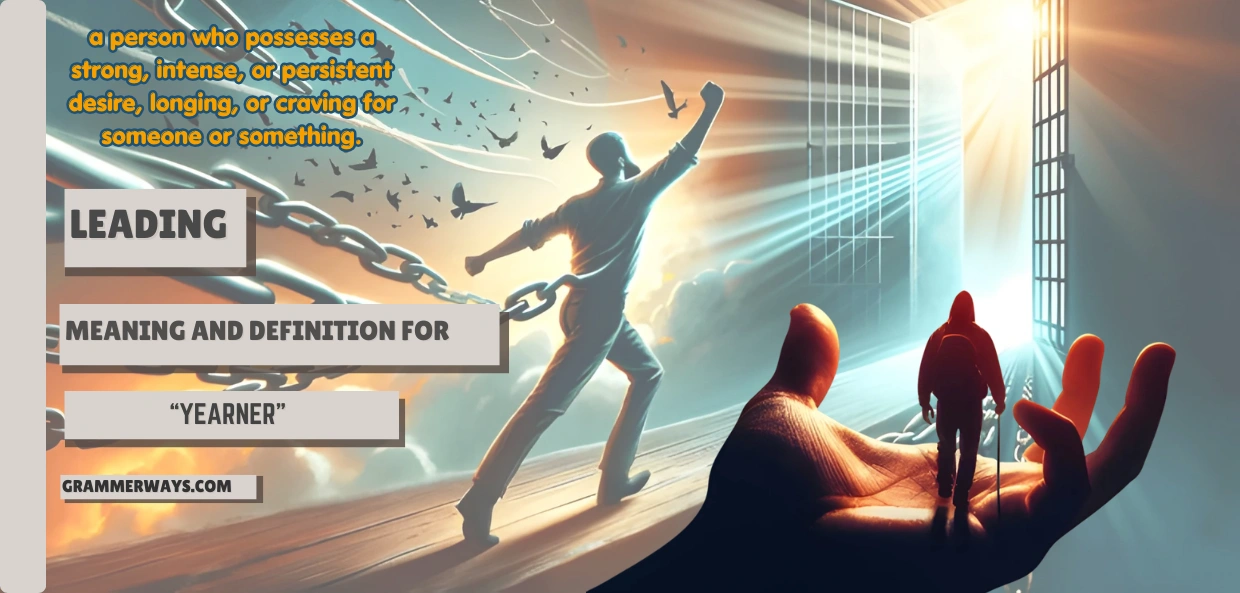
Yearner meaning covers more ground than most people expect at its core, a yearner is someone who deeply longs or craves something emotionally, romantically, or spiritually. The word also describes a sleep position: lying on your side with both arms stretched forward, reaching for something just out of grasp.
In relationships, the yearner meaning points to someone who craves deep emotional closeness but keeps a quietly guarded heart underneath. The word appears across psychology, sleep science, and everyday language each context adding its own layer.
The yearner meaning travels well across languages too. In Hindi, it’s तड़पने वाला one who burns with longing. In Tagalog, isang taong nagnanasa a person who intensely desires or yearns.
Yearner Definition: The Clean Dictionary Version
Yearner (noun)
A yearner is a person who yearns someone who experiences a persistent, deep longing or craving, often for something emotionally significant: love, belonging, purpose, or a life not yet lived.
Phonetic Spelling & IPA
- Phonetic: YURN-er
- IPA: /ˈjɜːr.nər/
- Syllables: year·ner (2 syllables)
- Rhymes with: burner, learner, turner
Part of Speech
Yearner is a noun an agent noun formed by adding the suffix -er to the verb yearn, meaning “one who yearns.”
The root verb yearn functions as an intransitive verb (you yearn for something, not yearn something directly).
Origin & Etymology: Where Did “Yearner” Come From?
The word yearn traces back to Old English giernan or geornan, meaning “to strive, desire eagerly, long for.” It shares ancestry with the Proto-Germanic root *gernaz, meaning “eager” or “desirous.”
- Old English: giernan — to desire, covet
- Middle English: yernen — to long, to grieve with desire
- Modern English: yearn → yearner (agent noun)
The suffix -er follows a productive English pattern: teach → teacher, burn → burner, yearn → yearner. It has been used in English to denote “one who performs an action” since at least the 13th century.
The noun yearner in its psychological and sleep-science usage became more prominent in the early 2000s, particularly after researcher Chris Idzikowski published findings in 2003 (later widely discussed through the 2020s) identifying six primary sleep positions and naming one of them the “yearner position.”
Did You Know? The word yearn appears in Old English religious texts to describe a spiritual aching a longing for God or heaven. Its emotional weight hasn’t diminished over a thousand years.
Yearner Meaning in Different Contexts
The word yearner doesn’t live in just one box. Depending on where you encounter it, the yearner meaning shifts in interesting ways.
1. The Emotional / General Meaning
In everyday English, a yearner is someone driven by deep internal longing. This is the most common literary and conversational usage.
A yearner feels a pull toward something a place, a person, a version of themselves that feels just out of reach. It’s different from simple “wanting.” Yearning carries weight. It’s ache, not just appetite.
Usage note: Yearner is often used approvingly or with empathy, not as a criticism. Calling someone a yearner suggests they have depth of feeling.
2. Yearner Sleeping Position
In sleep psychology, the yearner sleeping position refers to sleeping on one’s side with both arms stretched out in front, as if reaching for something.
According to research discussed in major sleep science publications through 2024–2025, the yearner position is associated with specific personality traits:
- Open-minded but cynical
- Slow to make decisions but once a decision is made, they stick with it firmly
- Suspicious of others initially, but deeply loyal once trust is established
- They “reach out” but also guard themselves
The name itself is poetic: arms extended forward, as if perpetually yearning for something just beyond reach.
Fun fact: In a 2025 review of sleep personality research compiled by the Sleep Foundation, the yearner position was identified as one of the more psychologically complex positions pairing openness with defensiveness in a way no other sleep pose does.
3. Yearner Meaning in Relationship
When people search yearner meaning in relationship, they’re usually trying to understand a pattern they recognize in themselves or a partner.
A yearner in a relationship is someone who:
- Craves deep emotional intimacy, not just surface-level connection
- Often feels an aching sense that something is missing, even in a loving relationship
- May idealize partners or relationships, projecting unmet needs onto them
- Reaches toward closeness but may pull back when things get too real a defense mechanism
Attachment theory (as discussed in 2024–2025 research from the Journal of Social and Personal Relationships) describes yearners as often leaning toward anxious attachment they long for closeness but fear abandonment.
This isn’t a flaw. It’s a pattern. And recognizing it is the first step toward more grounded, secure connection.
Edge case worth noting: Not every yearner in a relationship is anxiously attached. Some yearners are simply highly emotionally expressive people who bring intensity and passion to their partnerships which can be a genuine strength when channeled with self-awareness.
4. Yearner Meaning in Love
Yearner meaning in love is one of the most-searched variants and for good reason.
Love is perhaps the most classic context for yearning. A yearner in love:
- Feels romantic longing that goes beyond ordinary attraction
- May grieve relationships that never fully materialized
- Carries a bittersweet awareness of love’s fragility
- Often expresses love through acts of devotion and deep attentiveness
In literature, the yearner archetype in love appears everywhere from Emily Brontë’s Heathcliff to modern romance fiction’s brooding, passionate leads. It’s a universally human experience given a name.
5. Yearner Meaning in Hindi
For Hindi-speaking readers, the yearner meaning in Hindi translates most naturally as:
- तड़पने वाला (tadapne wala) — one who burns with longing
- लालायित व्यक्ति (lalaayit vyakti) — an eagerly desirous person
- अभिलाषी (abhilaashi) — one with deep desire or aspiration
The emotional weight in Hindi equivalents is substantial tadap (तड़प) captures not just desire but a kind of sweet pain, making it perhaps the most emotionally accurate translation.
6. Yearner Meaning in Tagalog
The yearner meaning in Tagalog is expressed through several related words:
- Nagnanasa — one who craves or desires intensely
- Naiimbot — one who longs for something unattained
- Mapangarapin — a dreamer, a hoper (close in feeling to yearner)
In Filipino culture, the concept of pagnanasa (deep longing or desire) is closely tied to emotional expressiveness, which makes yearner a culturally resonant concept even without a single direct translation.
Disclaimer: The information provided in this article is for educational and informational purposes only. All definitions, etymological references, translations, and psychological insights are based on widely recognized linguistic sources, published sleep research, and established language references available at the time of writing.
Synonyms & Antonyms
| Synonym | Meaning |
|---|---|
| Longer | One who longs deeply |
| Craver | One who craves something intensely |
| Piner | One who pines (especially in love) |
| Dreamer | One who wishes for things beyond reach |
| Aspirant | One who strives toward a goal |
| Idealist | One who believes in a better version of things |
| Antonym | Meaning |
|---|---|
| Realist | One focused on what is, not what could be |
| Contented person | One satisfied with the present |
| Pragmatist | One driven by practical action, not longing |
Words That Look Similar (But Mean Something Different)
| Word | Meaning |
|---|---|
| Earner | One who earns money or merit |
| Learner | One who learns |
| Burner | One who burns something; also a cheap phone |
| Turner | One who turns something; a surname |
Warning: Yearner and earner are a common typo trap. Double-check your spelling especially in formal writing.
Example Sentences
- She was a quiet yearner, always gazing at the horizon as if something just beyond it held the life she truly wanted.
- In the therapist’s office, he finally admitted he’d been a yearner his whole life chasing connections that somehow always felt incomplete.
- The yearner sleeping position arms stretched forward, knees slightly bent apparently says more about your personality than you’d expect.
- Understanding yearner meaning in relationship contexts helped her see why she kept feeling dissatisfied even in otherwise healthy partnerships.
- His poetry was pure yearner energy: every verse aching toward something beautiful and unnameable.
- The yearner meaning in Hindi tadapne wala captures the bittersweet quality of longing far better than the English alone.
- She described her grandmother as a lifelong yearner, someone whose heart was always half somewhere else, half in some other time.
Common Mistakes & Tips
Mistake 1: Spelling it “earner” or “yerner” The correct spelling is yearner year + -ner. Think: I yearned all year.
Mistake 2: Using “yearner” as an adjective ❌ She was yearner than before. ✅ She was more of a yearner than before. OR She yearned more than before.
Mistake 3: Confusing “yearner” with “dreamer” A dreamer imagines. A yearner aches. The distinction matters emotionally and in writing yearning carries more pain than dreaming.
Grammar note: Yearner takes regular plural: yearners. The possessive is yearner’s (singular) or yearners’ (plural).
Cultural & Contextual Insight
The yearner archetype is deeply embedded in Romantic-era literature (late 18th–19th century), where longing was practically a virtue. Keats, Shelley, and Byron were all, in a sense, yearners their work driven by aching desire for beauty, freedom, and transcendence.
In modern pop culture, the yearner shows up in music constantly. Songs about unrequited love, roads not taken, and lives almost lived that’s yearner territory.
In psychology, 2025 research from the American Psychological Association highlighted that people with higher “longing orientation” (a formal term closely related to the yearner personality) tend to score higher on empathy scales suggesting that the capacity to yearn deeply may be connected to emotional intelligence.
Tips to Remember the Word
- Visual anchor: Picture someone sleeping with their arms stretched out reaching, yearning in the classic yearner sleep pose.
- Word breakdown: Year + -ner. You yearn all year long.
- Emotional anchor: Think of the last time you felt a deep, bittersweet longing for something. That feeling? That’s what yearner names.
Related Word Family
| Word | Part of Speech | Meaning |
|---|---|---|
| Yearn | Verb | To long deeply for something |
| Yearning | Noun / Adjective | The act or state of longing; full of longing |
| Yearningly | Adverb | In a longing manner |
| Yearner | Noun | One who yearns |
| Yearned | Verb (past tense) | Longed for (in the past) |
Example: She yearned for connection. That yearning defined her. She was, at her core, a yearner someone who moved through the world yearningly, always reaching.
Reader Interaction
Which type of yearner resonates with you most the sleep-position kind, the romantic kind, or the philosophical kind who’s always reaching toward something more? Drop your answer in the comments. You might be surprised how many people recognize themselves in this one quiet word.
Read Also: Locksmith Meaning In Hindi
Conclusion
The yearner meaning is richer than it first appears. Whether you encounter it in a sleep personality quiz, a relationship psychology article, or a line of poetry, the word carries a consistent emotional core: someone who reaches, who longs, who feels the gap between what is and what could be.
That’s not a weakness. In many ways, yearner are among the most emotionally alive people around. If this word resonates with you in English, Hindi, Tagalog, or any other language carry it with confidence. You’ve just added a precise, beautiful word to your vocabulary for one of the most human experiences there is.
? FAQs About
Q1: Is “yearner” a formal or informal word?
Both. It works in psychological research, literature, and everyday conversation not slang, not stiff.
Q2: What does the yearner sleeping position say about your personality?
You’re open-minded but cautious. Slow to decide, but rock-solid once you do.
Q3: Can “yearner” be used negatively?
Rarely. It’s usually sympathetic though it can imply someone is stuck longing instead of acting.
Q4: What is the yearner meaning in love?
Someone who loves deeply and intensely, often with a bittersweet ache for connection that feels just out of reach.
Q5: How is “yearner” different from “romantic”?
A romantic celebrates love. A yearner aches for it. Close cousins but not the same feeling.
