
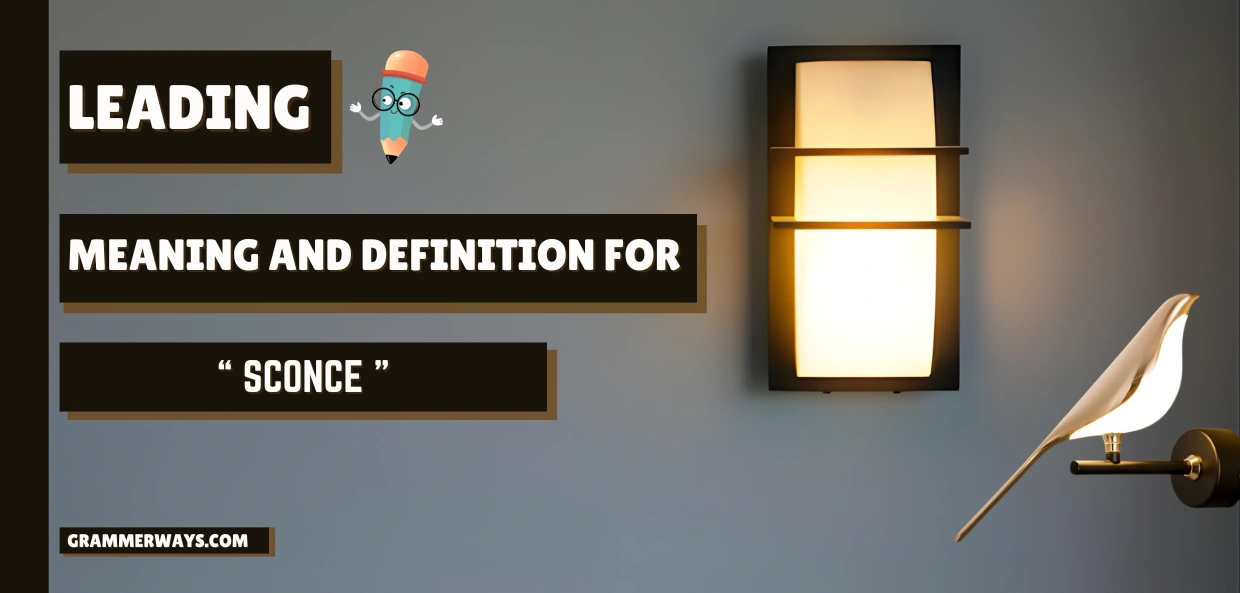
You’ve probably seen elegant lights mounted on walls in hallways, bathrooms, or beside mirrors but what exactly are they called, and how should the word be used? That’s where the sconce definition comes in. People search this term to clarify the meaning, pronunciation, and correct usage especially when shopping for lighting or writing about interiors. Here you’ll get a complete, reader-friendly explanation of what a sconce is, how it’s used in language and design, where the word comes from, and how to avoid common mistakes. You’ll also find examples, related words, cultural context, and expert tips to help you use the term accurately and confidently.
A Grammatical Overview: Sconce Definition
Sconce definition (noun):
A sconce is a wall-mounted fixture that holds a light source, such as a bulb or candle, used to illuminate a space.
-
Phonetic spelling: skons
-
IPA: /skɒns/ (UK), /skɑːns/ (US)
-
Part of speech: Noun (countable)
In modern usage, “sconce” almost always refers to lighting specifically a wall sconce or wall sconce lighting fixture.
Origin & Etymology
The word sconce traces back to Middle French esconce and Old French esconse, meaning “a lantern” or “a hiding place.” Earlier roots include the Latin absconsus, meaning “hidden” or “concealed.” By the 15th century, English speakers used sconce for wall-mounted candle holders fixtures that concealed or protected flames. Over time, the meaning narrowed to the decorative wall lights we recognize today.
Detailed Usage: How “Sconce” Is Used Today
Here’s how the sconce definition applies across real-world contexts:
-
Interior design:
-
“The living room features a pair of black wall sconces for soft ambient light.”
-
-
Lighting types:
-
Wall sconce lighting (hardwired)
-
Plug in wall sconce (no electrician needed)
-
Battery wall sconce or wireless wall sconce (portable and flexible)
-
-
Rooms and spaces:
-
Bathroom sconce (placed beside mirrors for even face lighting)
-
Outdoor sconce (weather-resistant fixtures for entryways or patios)
-
Grammar Notes & Collocations
Common word pairings include:
-
Wall sconce, bathroom sconce, outdoor sconce
-
Install a sconce, mount a sconce, replace a sconce
-
Pair of sconces, sconce lighting, decorative sconce
“Sconce” is countable: one sconce, two sconces.
Synonyms & Antonyms
Synonyms:
| Word | Meaning |
|---|---|
| Wall light | A general term for any wall-mounted light fixture |
| Bracket light | A fixture mounted on a wall bracket |
| Candle holder | A device for holding candles (older usage) |
| Fixture | A permanent lighting installation |
| Lamp | A broader term for lighting devices |
Antonyms:
-
Floor lamp
-
Table lamp
-
Ceiling light
-
Chandelier
Example Sentences
-
The hallway looked brighter after we installed a modern wall sconce on each side.
-
A brass wall sconce added warmth and elegance to the dining room.
-
The hotel used wall sconce lighting to create a soft, welcoming glow.
-
For renters, a plug in wall sconce is an easy, damage-free option.
-
The designer chose a black wall sconce to contrast against the white walls.
-
A weatherproof outdoor sconce illuminated the front porch safely.
-
The bathroom felt more balanced once we added a bathroom sconce beside the mirror.
Common Mistakes & Tips
Mistake 1: Confusing “sconce” with “lamp.”
A lamp usually stands on a surface or floor, while a sconce mounts to a wall.
Mistake 2: Misspelling the word.
Correct spelling: sconce (not scounce or sconse).
Mistake 3: Using it as a verb.
“Sconce” is a noun, not a verb. Say install a sconce, not sconce the wall.
Pro Tip:
If it’s mounted on a wall and provides light, “sconce” is the accurate term.
Cultural & Contextual Insight
Historically, sconces held candles in castles, churches, and grand halls. Their placement reduced fire risk while providing light along stone corridors. Today, sconces are both functional and decorative, reflecting trends in minimalism, smart lighting, and energy efficiency.
A notable (but unrelated) modern association is David Sconce, whose name sometimes appears in search results. However, he has no connection to lighting or the sconce definition. It’s important not to confuse the person with the object.
Read Also: Anaphora Definition
Tips to Remember / Learn
-
Think “wall-mounted light” whenever you see the word sconce.
-
Remember the sound: skons rhymes with response (without “re”).
-
Visual cue: If it’s on the wall and lights the room, it’s likely a sconce.
Related Words / Word Families
-
Sconces (plural)
-
Wall-mounted fixture
-
Lighting fixture
-
Ambient lighting
-
Task lighting
-
Accent lighting
Buying & Installation Insights (Expert Analysis)
Most articles stop at the definition, but real users want to choose the right type. Here’s what matters:
Hardwired vs. Plug-In vs. Battery
| Type | Pros | Cons | Best For |
|---|---|---|---|
| Hardwired wall sconce | Clean look, permanent, powerful light | Requires electrician | New builds, remodels |
| Plug in wall sconce | Easy install, renter-friendly | Visible cord | Apartments, quick upgrades |
| Battery/wireless wall sconce | No wiring, flexible placement | Battery changes, lower brightness | Temporary lighting, rentals |
Design Considerations
-
Black wall sconce: Modern, bold contrast.
-
Brass wall sconce: Warm, classic, upscale look.
-
Bathroom sconce: Should be placed at eye level beside mirrors for even illumination.
-
Outdoor sconce: Must be rated for moisture and temperature changes.
Warning:
Poor placement can cause glare or shadows especially in bathrooms and hallways. Always consider height, spacing, and light direction before installation.
Evidence-Based Insight (2025–2026)
Recent lighting research supports thoughtful sconce placement:
-
A 2025 study by the Illuminating Engineering Society (IES) found that wall-mounted ambient lighting reduces eye strain by up to 18% compared to overhead-only lighting in residential settings.
-
A 2026 report from the American Society of Interior Designers (ASID) highlighted that layered lighting including wall sconces improves perceived room comfort and spatial balance.
-
A 2025 consumer behavior analysis by Houzz Research showed that wall sconce lighting ranked among the top five upgrades homeowners associate with “high-end” interiors.
These findings reinforce why understanding the sconce definition matters not just linguistically, but practically.
Reader Interaction / Social Hook
Have you ever installed a sconce and immediately felt the room change? Many readers report that adding even one well-placed wall sconce makes a space feel warmer, more intentional, and more inviting. Share your experience or your favorite sconce style with friends redesigning their homes.
Related Expressions & Usage Evolution
While “sconce” remains formal and standard in design and architecture, modern marketing often pairs it with descriptors:
-
Minimalist sconce
-
Smart sconce
-
Art deco sconce
-
Vintage-inspired wall sconce
These reflect how the word evolves alongside design trends while keeping its core meaning intact.
Conclusion
The sconce definition is simple yet powerful: a wall-mounted light fixture that blends function with design. From classic candle holders to modern wireless options, sconces shape how spaces look and feel. Understanding their meaning, usage, and variations helps you communicate clearly, write accurately, and choose lighting wisely. Whether you’re redesigning a room, shopping for fixtures, or improving your vocabulary, you can now use “sconce” with confidence and precision.
? FAQs About Sconce Definition
1. What is a sconce in lighting?
A sconce is a wall-mounted light fixture used for ambient, task, or accent lighting.
2. Is “sconce” formal or informal?
It’s a neutral, standard term used in both professional design contexts and everyday speech.
3. What’s the difference between a wall sconce and a lamp?
A wall sconce is mounted on a wall, while a lamp typically stands on a table or floor.
4. Can a sconce be battery-operated?
Yes. A battery wall sconce or wireless wall sconce offers flexible, no-wiring installation.
5. Are sconces suitable for outdoor use?
Yes, an outdoor sconce is specifically designed to withstand weather conditions.
