
Introduction
In the automotive and consumer electronics industries, the traditional approach to finishing plastic parts—relying on secondary processes like painting and printing—faces significant and growing challenges. Persistent issues include high scrap rates (often 10-15%), costly VOC emission treatment, susceptibility to wear, and failures like yellowing or peeling under extreme temperatures and UV exposure, leading to product recalls and brand damage.
This article provides an in-depth analysis of Film Insert Molding, a transformative integrated manufacturing technology. By combining pre-decorated functional films with resin substrates in a single molding cycle, it achieves true “decoration-structure integration.” This process demonstrably reduces cost, boosts yield, and enhances long-term product reliability. The following sections will dissect this revolutionary approach across five key dimensions.
What is Film Insert Molding, and Why Can It Revolutionize Traditional Plastic Parts Manufacturing?
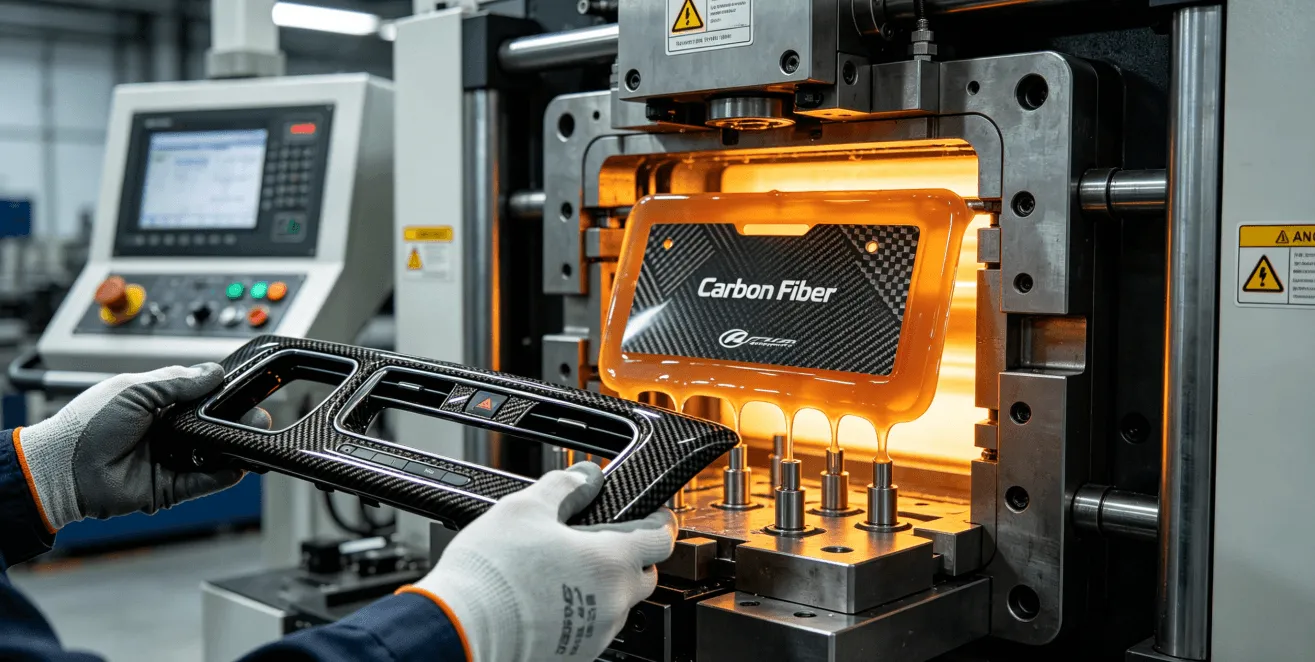
Film Insert Molding (FIM) is an advanced Injection Molding Solutions wherein a pre-decorated functional film is placed into a mold and back-injected with resin, creating a seamless, finished plastic components in a single step. This process integrates aesthetics, protection, and structure simultaneously. Compared to traditional “mold-then-decorate” methods, it offers revolutionary advantages: significant cost reduction (30%-50% lower per part), enhanced quality with yields reaching 95-98% by eliminating secondary processing errors, and superior design freedom for complex 3D textures and integrated functionalities like scratch-resistance. These benefits make Insert Molding Principles and Their Applications the preferred choice for meeting the stringent demands of Precision Custom Parts in sectors like automotive and premium electronics, where aesthetics, durability, and cost-efficiency are paramount.
How to Overcome the Core Challenges of Film Insert Molding: Material Pairing and Process Control?
Success in Film Insert Molding hinges on mastering two interconnected domains: material science and precision process control. Overcoming these challenges is what separates a prototyping attempt from a robust, high-yield production process.
Material Science: The Foundation of a Lasting Bond
The core challenge is ensuring perfect compatibility between the film and the plastic molding material. Incompatibility, particularly in thermal expansion coefficients, leads to defects like film wrinkling, ink washout, or delamination. A proven reliable combination, for instance, pairs a PC/ABS substrate with a PMMA-based film. This pairing, when processed correctly, can achieve peel strength that meets demanding automotive standards for over 5 years of service life. The selection of films—whether single-layer, multi-layer composites, or those with integrated hard coats—is a critical engineering design support activity.
The Pursuit of Process Precision
The film insert molding process demands extreme control over every parameter to protect the pre-placed film and ensure perfect bonding.
- Mold Precision
The mold must have precision locating pins and vacuum systems to hold the film perfectly flat and stationary. Pin clearance is typically controlled within 0.05-0.15mm to prevent film shift during clamp-up and injection.
- Injection Parameter Optimization
The injection phase requires a “soft touch.” A low-speed, high-pressure injection profile is used to carefully control the melt front speed, preventing it from disturbing or damaging the printed layer on the film. Advanced manufacturers use Moldflow analysis to simulate and optimize these parameters before cutting steel.
The Critical Role of Early-Stage Engineering Collaboration
Perhaps the most crucial factor for success is engaging expert Engineering Design Support from the project’s inception. A comprehensive Design for Manufacturability (DFM) analysis can identify and mitigate up to 80% of potential risks related to part geometry, gate location, and wall thickness. Partners who offer this proactive support ensure a smoother transition from design to production. For a deeper dive into the technical nuances, readers can explore this detailed resource on professional Film Insert Molding Technology Solutions.
In the Automotive Sector, How Does Film Insert Molding Solve the Dual Challenge of Weather Resistance and High Yield?
Automotive interior trim components face some of the harshest operating environments, requiring unwavering durability under intense UV exposure, temperature cycling, and chemical exposure. Standards like GMW16717 test this resilience through prolonged high-temperature/humidity, thermal shock, and UV aging cycles. This is where the value of film-insert molding is rigorously proven.
A real-world case highlights this: a new energy vehicle brand faced massive recalls after center console panels exported to the Middle East exhibited severe yellowing and peeling. The root cause was the failure of traditional paint under extreme UV and heat. The solution involved switching to a film insert molding process using a multi-layer composite PMMA/ASA film (formulated with high-load UV absorbers) bonded to a PC/ABS substrate. The resulting plastic components passed stringent testing, including 1500 hours of QUV accelerated weathering and -40°C to 105°C thermal cycling, guaranteeing a 5-year service life and eliminating the recall risk.
This case underscores the core advantage: unlike a painted layer that sits on the surface, the decorated film in FIM is encapsulated and protected by the resin behind it. This creates a far more stable and reliable bond, offering superior weatherability and adhesion that directly addresses the automotive industry’s most critical pain points.
How Does Film Insert Molding for Consumer Electronics Housings Balance Aesthetics with Efficiency?
The consumer electronics housing market demands Precision Custom Parts that push the limits of aesthetics, haptics, and miniaturization, all while requiring rapid design iterations and strict cost control.
Film insert molding is uniquely suited to these demands. It allows for the integration of complex, high-resolution textures (like precise geometric patterns or soft-touch surfaces) and brand logos in a single step, eliminating secondary assembly. Furthermore, functional coatings such as anti-fingerprint (AF) and hardening (HC) layers can be pre-applied to the film, delivering a ready-to-use part straight from the mold.
From an efficiency standpoint, while the molding cycle may be 5-8 seconds longer due to film loading, it eliminates the entire downstream workflow of painting/printing, curing, masking, and associated quality inspections. This consolidation dramatically reduces the total production cycle time, work-in-progress inventory, and factory footprint. The result is a faster time-to-market and lower total cost, making it an ideal Injection Molding Solutions for the fast-paced, cost-conscious electronics industry.
How to Select a Partner and Evaluate Their Capabilities for a Successful Film Insert Molding Project?
Choosing the right manufacturing partner is as critical as the technology itself. Success depends on capabilities that go far beyond just owning an injection molding machine. Essential Dual Expertise for a Partner
The ideal partner must possess a dual competency: both deep foundational knowledge and practical production mastery. Firstly, they require comprehensive theoretical understanding of the film insert molding process and material science principles. More critically, they must couple this with extensive hands-on experience in mass production. This combination ensures they can effectively bridge the gap from prototyping to stable, high-volume manufacturing, guaranteeing robust process capability and yield.
A Practical Partner Evaluation Framework
Selecting the right manufacturer requires moving beyond general claims to a concrete, actionable evaluation.
- Technical Collaboration and Validation
Prospective partners should be assessed on their proactive support infrastructure. Key questions include: Do they offer free, detailed DFM analysis? Is a dedicated Engineering Design Support team available for collaboration? Furthermore, the presence of in-house testing labs for peel strength, QUV weathering, and other validations is a strong indicator of technical seriousness and self-sufficiency.
- Proven Performance and Systems
Evaluation must also focus on demonstrable outcomes and systemic quality. Critical inquiries involve their proven production yield data—does it consistently meet or exceed 98%? Equally important are formal certifications like IATF 16949, which serve as proof of a systematic, high-reliability manufacturing and quality management system essential for automotive-grade components.
Conclusion
In summary, Film Insert Molding is not merely a process substitution but a systematic Injection Molding Solutions that addresses the root causes of surface finishing issues in plastic components. By enabling true integration of decoration and structure, it simultaneously enhances aesthetic quality, long-term reliability, and environmental performance while delivering significant cost savings. It has become an essential technology for advanced manufacturing.
If you are facing the challenges of high cost, low yield, or product failure risks associated with traditional painting processes, it is time to evaluate this technology. Contact our team of technical experts at JS Precision for a customized Film Insert Molding process assessment and feasibility report for your specific component.
Author Bio
The author is a precision manufacturing and materials engineering expert with over 15 years of experience, specializing in injection molding and surface treatment technologies. Dedicated to providing advanced Engineering Design Support and manufacturing solutions for the automotive and consumer electronics industries.
FAQs
Q1: What is the difference between Film Insert Molding and In-Mold Labeling (IML)?
A: IML is primarily used for simple label decoration on flat or simple curved surfaces, using thin films. Film Insert Molding employs thicker, multi-layer functional films that provide both decoration and protective properties (like scratch and weather resistance), making it suitable for high-performance applications like automotive interiors and consumer electronics housings.
Q2: How much cost can typically be saved by switching to Film Insert Molding?
A: Based on industry cases, for a component like an automotive interior trim part with an annual volume of 100,000 units, Film Insert Molding can reduce total cost by 30%-50% compared to traditional painting. This stems from yield increases (to 98%+), process simplification, and the elimination of VOC treatment capital and operating costs.
Q3: How do I select the most suitable film and plastic substrate for my product?
A: Selection is primarily based on chemical compatibility and matching thermal expansion coefficients to prevent stress. A common reliable pairing is PC/ABS substrate with PMMA-based films. Final selection must be validated through adhesion (peel strength) and environmental resistance testing. It is highly recommended to conduct joint evaluation with a supplier possessing material science expertise early in the project.
Q4: What are the key design considerations to ensure Film Insert Molding success?
A: Critical design points include: avoiding sharp corners in film-covered areas (minimum radius ≥0.3mm), optimizing gate location to prevent melt from directly impacting printed film areas, and ensuring uniform wall thickness (recommended 1.5-3.0mm) to minimize differential shrinkage and warpage. Professional DFM analysis is vital.
Q5: Are manufacturer certifications like IATF 16949 important for a Film Insert Molding project?
A: Absolutely critical. Certifications like IATF 16949 demonstrate the manufacturer has a stringent, process-oriented quality management system required by the automotive industry. This ensures process stability, control, and product traceability, forming the basic threshold for any plastic components project demanding zero defects and high reliability.
