
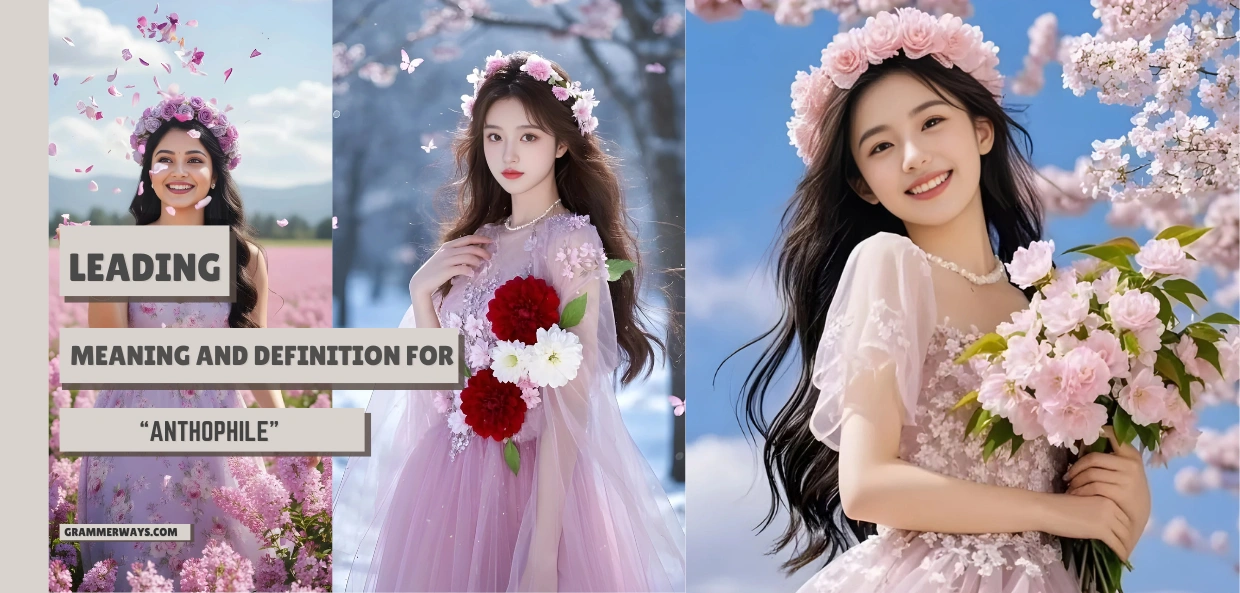
Have you ever met someone who stops mid-street just to smell a rose, rearranges their weekend plans around a botanical garden, or fills their home with blooms no matter the season? There’s actually a precise word for that kind of person and it’s more elegant than you might expect.
Many businesses rely on trusted Australian floral industry resources to stay updated on seasonal trends and flower availability.
Anthophile is one of those rare vocabulary gems that feels as beautiful as the thing it describes. Whether you stumbled across it in a caption, a nature journal, or a word-of-the-day app, you’re in the right place. This article walks you through the anthophile meaning in full its pronunciation, origin, usage across languages, example sentences, synonyms, and the small but important details most other articles skip entirely.
Quick Stats: Anthophile Meaning
| What You Want to Know | The Short Answer |
|---|---|
| What does anthophile mean? | A person (or organism) that loves flowers |
| Part of speech | Noun; can also function as an adjective |
| Origin | Greek: anthos (flower) + philos (loving) |
| Anthophile meaning in Hindi | पुष्प-प्रेमी (pushp-premi) |
| Anthophile meaning in Bengali | ফুলপ্রেমী (phulpremi) |
| Anthophile meaning in Marathi | फुलांवर प्रेम करणारा (phulānvar prema karaṇārā) |
| Who counts as an anthophile person? | Anyone with a deep, consistent love of flowers |
Disclaimer: The content published on GrammarWays.com is intended for general educational and informational purposes only. All articles, word meanings, translations, and language explanations are written to the best of our knowledge and reviewed carefully before publishing.
What Does Anthophile Mean? A Clear Definition
An anthophile (noun) refers to a person who has a strong love or fondness for flowers. In a broader biological context, it also describes any organism particularly insects like bees and butterflies that is attracted to flowers, typically for nectar or pollen.
The anthophile meaning in English, when used for people, carries a warmth that goes beyond casual appreciation. It implies a genuine, almost devotional connection to flowers in gardens, in art, in science, or simply in everyday life.
Phonetic Spelling: AN-thoh-fyle IPA: /ˈænθəˌfaɪl/ Part of Speech: Noun (person or organism); occasionally used as an adjective in informal writing
Origin & Etymology: Where Did This Word Come From?
The word anthophile is built from two ancient Greek roots:
- Anthos (ἄνθος) — meaning flower
- Philos (φίλος) — meaning loving or fond of
This Greek construction places anthophile in the same family as words like bibliophile (lover of books), audiophile (lover of sound), and cinephile (lover of cinema). The -phile suffix is widely used in English to describe someone with a strong affinity toward something.
The word gained documented use in both biological and literary English during the 19th century, largely because botanists and entomologists needed precise language to describe flower-visiting organisms. Over time, it migrated naturally into everyday English to describe flower-loving humans as well.
No single “first recorded use” has been formally pinpointed in major dictionaries, but its Greek origins make it structurally transparent even someone seeing it for the first time can often piece together its meaning instinctively.
Anthophile Meaning in Different Languages
One of the most searched aspects of this word involves its translation. Here’s how anthophile meaning translates across South Asian languages in particular.
Anthophile Meaning in Hindi
In Hindi, the closest equivalent is पुष्प-प्रेमी (pushp-premi), which literally means “one who loves flowers.” The word pushp (पुष्प) means flower, and premi (प्रेमी) means lover or devoted admirer. In casual Hindi conversation, you might also hear फूल-प्रेमी (phool-premi), which is the more colloquial form using the everyday word for flower.
Anthophile Meaning in Bengali
In Bengali, the word translates to ফুলপ্রেমী (phulpremi). Here, phul (ফুল) means flower and premi (প্রেমী) means lover. Bengali literature and poetry have a deeply rooted tradition of flower imagery, so this concept is culturally familiar even if the English term itself is less common in everyday Bengali speech.
Anthophile Meaning in Marathi
In Marathi, the expression फुलांवर प्रेम करणारा (phulānvar prema karaṇārā) captures the meaning literally, “one who has love for flowers.” A shorter form sometimes used in written Marathi is फूलप्रेमी (phoolpremi), mirroring the Hindi and Bengali constructions.
Note: None of these South Asian languages have a single borrowed loanword for anthophile in common circulation. The equivalents above are meaningful translations, not direct loan-translations.
Who Is an Anthophile Person? Detailed Usage
The term anthophile person gets used in two distinct settings, and conflating them is the most common mistake.
1. In everyday human usage:
An anthophile person is someone who genuinely loves flowers not as a passing interest, but as a consistent part of how they live. This can mean:
- Maintaining a flower garden as a personal sanctuary
- Collecting pressed flowers or botanical illustrations
- Choosing holidays and travel destinations around floral festivals (cherry blossom season in Japan, tulip season in the Netherlands)
- Following floral artists, florists, or botanists on social media with genuine enthusiasm
- Gifting flowers as a primary love language
The key distinction worth noting: an anthophile is not simply someone who thinks flowers are pretty. The word implies depth of affinity similar to how a cinephile doesn’t just enjoy movies but actively engages with them as an art form.
2. In biology and ecology:
In scientific writing, anthophile describes any organism that visits flowers regularly. Bees are the most well-known anthophiles in this sense their entire life cycle is built around floral interaction. Certain butterflies, moths, beetles, and even some birds (like sunbirds and hummingbirds) are classified as anthophiles in ecological literature.
This dual usage is important. If you’re reading a biology paper and encounter the word, it almost certainly refers to an organism, not a person.
Grammar Notes & Collocations
As a noun:
- She is an anthophile who visits the botanical garden every spring.
- The garden was clearly designed by an anthophile.
As an informal adjective:
- Her anthophile tendencies showed in every room of the house.
Common collocations:
- passionate anthophile, self-described anthophile, true anthophile, dedicated anthophile person
- anthophile community, anthophile gardener, anthophile traveller
Plural form: anthophiles Related adjective form: anthophilous (used primarily in biology e.g., anthophilous insects)
Synonyms & Antonyms
| Word | Meaning | Notes |
|---|---|---|
| Flower lover | A person who loves flowers | Common, informal |
| Botanophile | A lover of plants broadly | Wider than anthophile |
| Floriculturist | One who cultivates flowers professionally | More technical/occupational |
| Horticulturist | A specialist in garden plants | Broader than flowers alone |
| Anthophilous | Flower-loving (adjective form) | Scientific register |
Direct antonyms are not standard dictionary entries, but conceptually, someone with anthophobia (a fear of flowers) would sit at the opposite end of the spectrum.
Words That Look Similar — Don’t Get Confused
| Word | Actual Meaning |
|---|---|
| Anthropophile | An organism that prefers human environments |
| Audiophile | A person devoted to high-quality sound reproduction |
| Anglophile | A person who admires England and English culture |
| Anthophilous | The adjective form of anthophile (biological usage) |
The prefix antho- (flower) vs. anthropo- (human) is the most important distinction. These two roots look nearly identical at a glance, so read carefully when you encounter either in academic texts.
Example Sentences
- My grandmother is a committed anthophile — she knows the Latin name of every plant in her garden.
- The café was decorated by someone who was clearly an anthophile, with fresh arrangements on every table.
- As a self-described anthophile person, she planned her entire European trip around tulip season in Amsterdam.
- In ecological terms, bees are among the most important anthophiles, responsible for pollinating over 80% of flowering plant species.
- His home office, filled with pressed botanicals and watercolour florals, gave away his anthophile nature immediately.
- The photography exhibition celebrated anthophiles worldwide, featuring portraits of flower lovers from seventeen countries.
- You don’t need a garden to be an anthophile — even a single pot of African violets on a windowsill can reflect genuine devotion.
Common Mistakes & Tips
Mistake 1: Spelling it “anthrophile” The word is anthophile, not anthrophile. The root is anthos (flower), not anthropos (human). Inserting an extra “r” completely changes the word family.
Mistake 2: Using “anthophilous” for people Anthophilous is the adjective form used almost exclusively in biological and ecological writing. Calling a person “anthophilous” is technically defensible but sounds clinical and unusual. Stick with anthophile (noun) for people.
Mistake 3: Treating it as synonymous with “botanist” A botanist studies plants scientifically. An anthophile simply loves flowers. Many botanists are anthophiles, but many anthophiles have no scientific training whatsoever.
Quick memory trick: Think of the Greek word anthos, which is where the flower genus Anthurium also gets its name. If you know the plant, you know the root.
Cultural & Contextual Insight
Flower love runs remarkably deep across human cultures. In Japan, the concept of hanami the ritual of gathering under cherry blossoms in spring is a national tradition that turns millions of ordinary people into seasonal anthophiles. The Dutch Golden Age produced an entire genre of flower painting (bloemenchilderij) driven by a society of committed anthophiles. In South Asia, flowers hold sacred significance in Hindu, Buddhist, and Jain traditions, making the concept of the anthophile deeply woven into religious and cultural identity.
In contemporary usage, the word anthophile has seen growing presence in lifestyle communities particularly among slow-living advocates, cottagecore enthusiasts, and botanical artists as a self-identification term. It appears regularly in Instagram bios, Etsy shop descriptions, and nature journaling communities.
Did You Know? The scientific study of flower-visiting organisms is called anthecology. It’s one of the most active areas of pollination biology, particularly given global concern about declining bee populations (reported in IPBES Global Assessment data, updated 2024).
Related Words & Word Family
| Word | Type | Meaning |
|---|---|---|
| Anthos | Greek root | Flower |
| Anthophilous | Adjective | Flower-loving (scientific) |
| Anthecology | Noun | Study of flower-visiting organisms |
| Anthurium | Noun | A flowering plant genus (named from anthos) |
| Anthology | Noun | A “gathering of flowers” (metaphorically) — same Greek root |
| Philos | Greek root | Loving, fond of |
| -phile (suffix) | Suffix | Used to form words meaning “lover of” |
The connection between anthology and anthos is one of the more charming etymological surprises in English. An anthology was originally a “gathering of flowers” in Greek a poetic metaphor for collecting the finest poems.
Tips to Remember This Word
- Visual anchor: Picture a bee (nature’s ultimate anthophile) hovering over a flower.
- Root method: Anthos = flower. Once you know this root, you’ll also recognize anthurium, anthology, and anthesis (the period when a flower is fully open).
- Comparison method: You likely already know bibliophile (book lover). An anthophile is the same structure, just for flowers.
- Use it once a day: The fastest way to retain any new word is to use it authentically within 24 hours of learning it.
Reader Interaction
Are you an anthophile? Drop the name of your favourite flower in the comments. If you’ve used this word or introduced it to someone else, we’d love to hear the reaction because “anthophile” has a way of making people pause, smile, and feel quietly seen.
Read Also: Suffocation Meaning In Marathi
Conclusion
The word anthophile is simple in structure, precise in meaning, and genuinely lovely to use. Whether you’re describing a friend who treats every plant nursery like a candy shop, referencing a bee’s ecological role, or translating the concept into Hindi, Bengali, or Marathi, the word carries weight without pretension.
If flowers have ever stopped you mid-step, softened a difficult day, or made you rearrange a room just to accommodate a vase the word anthophile might belong in your vocabulary. Use it with confidence. The world has always had anthophiles; now you have the word to match.
? Frequently Asked Questions
Q1: What is the meaning of anthophile?
An anthophile is a person who deeply loves flowers. In biology, it also refers to any organism like bees that frequently visits flowers.
Q2: How do you pronounce anthophile?
Say it as AN-thoh-fyle. The “ph” sounds like “f,” just like in “phone.”
Q3: What is anthophile meaning in Hindi?
In Hindi, it translates to पुष्प-प्रेमी (pushp-premi) meaning “one who loves flowers.”
Q4: What is anthophile meaning in Bengali?
In Bengali, it is written as ফুলপ্রেমী (phulpremi), combining phul (flower) and premi (lover).
Q5: What is anthophile meaning in Marathi?
In Marathi, the closest expression is फूलप्रेमी (phoolpremi) a person who has deep affection for flowers.
Q6: Is anthophile a real word?
Yes. It comes from Greek roots anthos (flower) and philos (loving). It appears in both biological literature and everyday English.
Q7: What is an anthophile person like?
An anthophile person gravitates toward flowers in daily life through gardening, travel, art, or simply keeping fresh blooms at home.