
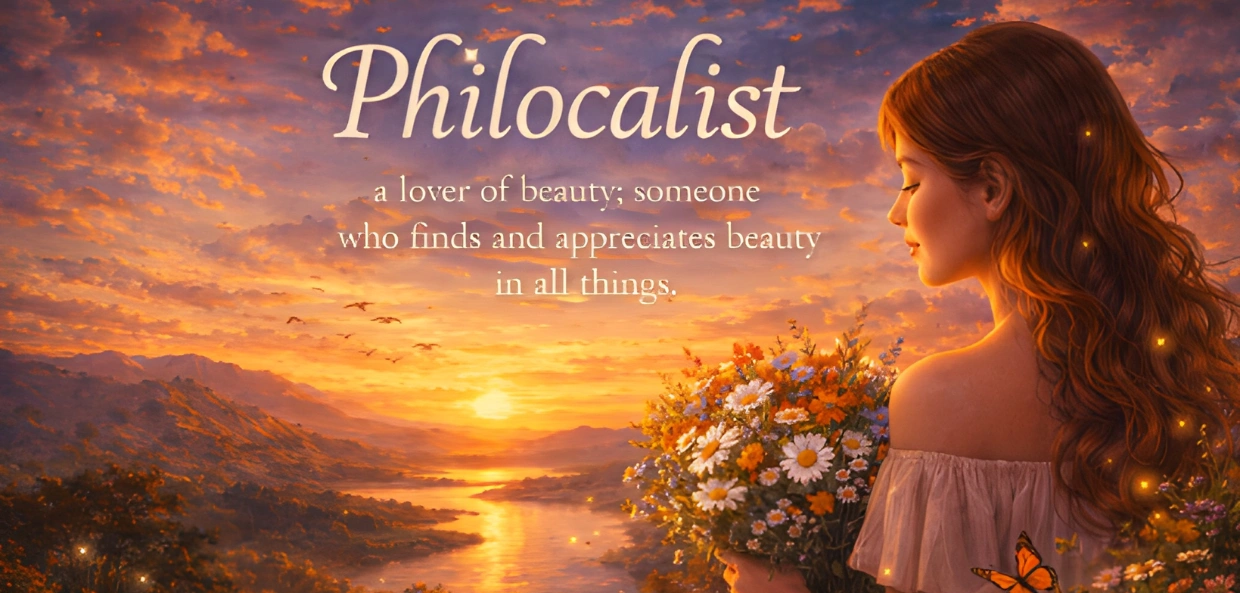
Search “Philocalist Meaning” and you’ll see why it’s trending.
Social media users, especially on Instagram and Pinterest, have been using #philocalist to caption posts about art, architecture, moody photography, and slow living. The word feels like it was pulled from a lost Victorian dictionary quietly poetic, deeply personal, and somehow more satisfying than just saying “I like pretty things.”
But what does it actually mean? Where does it come from? And how do you use it without sounding pretentious?
Here we Includes the philocalist definition in full pronunciation, etymology, grammar, synonyms, example sentences, and the subtle cultural weight this word carries.
Philocalist Meaning — Clear Definition
| Attribute | Details |
|---|---|
| Word | Philocalist |
| Meaning | A person who loves beauty |
| Part of speech | Noun |
| Pronunciation | fil-oh-KAY-list |
| Origin | Greek — philos (love) + kalos (beauty) |
| Synonym | Aesthete |
| Antonym | Philistine |
Philocalist (noun): A person who loves beauty; one who seeks out and appreciates beauty in its many forms — visual, auditory, natural, or conceptual.
It’s not about vanity or aesthetics as a hobby. A true philocalist sees beauty as a way of moving through the world — noticing the light on a brick wall, feeling moved by a well-chosen word, or pausing over a perfectly brewed cup of tea.
Philocalist Meaning in English — Breakdown
| Element | Meaning |
|---|---|
| Philo- | Lover of / one who loves |
| -kalist | Beauty (from Greek kalos) |
| Combined | One who loves beauty |
Pronunciation — How to Say It Correctly
Getting this right matters, especially if you plan to use it aloud.
Philocalist pronunciation in English:
- Phonetic: fil-oh-KAY-list
- IPA: /ˌfɪl.əˈkeɪ.lɪst/
- Syllables: phi · lo · cal · ist
- Stress: on the third syllable — KAY
Common mistake: Many people stress the first syllable (FIL-oh-calist). That’s understandable, but the natural rhythm falls on -cal-.
Quick memory trick: Think of it like “philo-KAY-list” as if someone’s handing you a key that opens up the world of beauty.
Origin & Etymology — Where Did This Word Come From?
The philocalist definition sits at the intersection of two ancient Greek words:
- φίλος (philos) — loving, fond of
- καλός (kalos) — beautiful, noble, fine
The suffix -ist (from Latin -ista, Greek -istēs) turns it into a noun denoting a person who practices or embodies something.
Greek-derived “philo-” words have been in English use since at least the 16th century. Think of philanthropist (lover of humanity), philosopher (lover of wisdom), and philologist (lover of language). Philocalist follows the exact same pattern.
While the word doesn’t appear prominently in classical literature, it gained quiet circulation in Victorian-era language, a period when precise emotional and philosophical vocabulary was fashionable among educated circles in Britain. Its modern revival is largely driven by digital culture, where niche vocabulary spreads fast when it feels true to people.
Did You Know? The Greek word kalos didn’t only mean physically beautiful it also carried meanings of moral goodness, nobility, and excellence. So a philocalist, in the truest ancient sense, was someone who loved all forms of beauty: ethical, aesthetic, and intellectual.
Detailed Usage — Different Contexts, Same Core Meaning
The philocalist meaning stays consistent, but it applies across very different situations.
As a Personal Identity Label
People now use it the way they’d use “bookworm” or “cinephile” as a one-word description of how they relate to the world.
“I’m a philocalist at heart I can’t walk through a market without stopping to look at the colors.”
In Art & Creative Contexts
Philocalist art refers to work made by someone deeply moved by beauty not art that simply depicts beautiful things, but art that emerges from a genuine sensitivity to the world. A philocalist artist doesn’t chase trends; they chase feeling.
Philocalist designs — a term used in branding, interior design, and fashion often means work that prioritizes elegance and visual harmony over novelty or utility alone.
On Social Media (#philocalist Latest)
The hashtag #philocalist is used across Instagram, Pinterest, and Tumblr to mark posts involving:
- Moody, atmospheric photography
- Slow travel imagery
- Handwritten notes and botanical illustrations
- Minimalist interiors and sunrise skies
It signals an aesthetic sensibility, not just a hobby.
Grammar Notes — How to Use It Correctly
| Form | Example |
|---|---|
| Noun (singular) | She is a philocalist. |
| Noun (plural) | Philocalists tend to notice details others miss. |
| Adjective form | She has philocalistic sensibilities. (less common) |
| Related verb | No standard verb form exists in English. |
Collocation note: The word pairs naturally with verbs like be, consider oneself, identify as, and call oneself. You wouldn’t typically say “she philocalized” there’s no accepted verb.
Philocalist Meaning in Hindi, Gujarati & Malayalam
This word has gained interest across South Asia, particularly among people studying English vocabulary or searching for poetic equivalents in their native languages.
Philocalist Meaning in Hindi with Example
हिंदी अर्थ: सौंदर्य-प्रेमी — वह व्यक्ति जो सुंदरता से प्रेम करता है।
Philocalist meaning in Hindi (Oxford-style): संज्ञा — वह व्यक्ति जो हर रूप में सुंदरता की सराहना करता है।
Example (Philocalist meaning in Hindi and examples):
“वह एक सच्चा philocalist है — वह हर साधारण चीज़ में कुछ खूबसूरत देखता है।”
(He is a true philocalist — he sees something beautiful in every ordinary thing.)
Philocalist Meaning in Gujarati
ગુજરાતી અર્થ: સૌંદર્ય-પ્રેમી — જે વ્યક્તિ સૌંદર્યને ચાહે છે અને તેની કદર કરે છે.
Philocalist Meaning in Malayalam
മലയാളം അർഥം: സൗന്ദര്യ പ്രേമി — സൗന്ദര്യത്തെ സ്നേഹിക്കുന്ന വ്യക്തി.
Synonyms & Antonyms
Philocalist Meaning Synonyms
| Word | Meaning |
|---|---|
| Aesthete | One devoted to beauty and artistic taste |
| Sensualist | One who appreciates sensory pleasure and beauty |
| Connoisseur | An expert appreciator of art or fine things |
| Beauty-lover | Plain English equivalent |
| Romantic | One who sees the world through a lens of beauty and feeling |
Edge case worth noting: “Aesthete” is the closest direct synonym, but it carries a slightly elitist or affected connotation in some contexts. “Philocalist” feels warmer and less snobbish more personal than performative.
Antonyms
| Word | Meaning |
|---|---|
| Philistine | One indifferent or hostile to art and beauty |
| Barbarian (figurative) | One who disregards culture and refinement |
Words That Look Like Philocalist (But Aren’t the Same)
These words share roots with philocalist and are worth knowing:
- Philanthropist: lover of humanity
- Philosopher: lover of wisdom
- Philologist: lover of language and words
- Bibliophile: lover of books
- Kaleidoscope: from kalos (beautiful) + eidos (form) + skopein (to look)
Noticing the pattern? The Greek prefix philo- is remarkably productive in English. Once you know it, you’ll spot it everywhere.
Example Sentences
- “Every philocalist knows that beauty isn’t reserved for galleries it lives in cracked pavements and fog-covered mornings.”
- “She called herself a philocalist not because she studied art, but because she genuinely couldn’t pass a flowering weed without stopping.”
- “The photographer’s work has a quiet, deeply philocalistic quality every frame feels chosen rather than taken.”
- “To define philocalist simply as ‘someone who likes pretty things’ misses the point entirely it’s about a fundamental orientation toward the world.”
- “His apartment was arranged like a philocalist’s dream: warm light, carefully chosen objects, and not a single thing that didn’t earn its place.”
- “The brand describes its work as philocalist design meaning every product is made to feel as good as it looks.”
- “I didn’t know the word until I saw it on a stranger’s bio, but reading the philocalist meaning felt like finally being handed the right label.”
Common Mistakes & How to Avoid Them
1. Spelling it wrong
The most common errors: philocalist, phylocalist, philocalyst. The correct spelling is philocalist no Y, no extra letters.
2. Mispronouncing the stress
Stress falls on the third syllable: fil-oh-KAY-list. Not FIL-oh-calist.
3. Using it as a verb
There’s no accepted verb form. Don’t write “she philocalized the space.” Use it as a noun or adjective only.
4. Confusing it with “hedonist”
A hedonist pursues pleasure. A philocalist appreciates beauty. These overlap but aren’t interchangeable. Beauty isn’t always pleasurable sometimes it’s melancholy, strange, or uncomfortable.
Cultural & Contextual Insight
The word “philocalist” didn’t go viral by accident.
It fills a specific emotional gap in modern English: the need to describe someone who is moved by beauty as a practice not just as a hobby or preference. In a culture that increasingly values productivity, utility, and efficiency, calling yourself a philocalist is almost a mild act of resistance. It says: I slow down for beauty. I think it matters.
This is part of why philocalist designs and philocalist art have become genuine aesthetic movements in the creative world particularly among independent makers, visual artists, and slow-living communities.
The word also travels well across languages and cultures. The Greek roots are internationally recognizable, which is why searches for philocalist meaning in Hindi, Gujarati, and Malayalam have grown steadily throughout 2025–2026 as global English vocabulary interest rises.
Tips to Remember the Word
- Root trick: Philo = love (think: philosophy). Cal = beauty (think: calligraphy beautiful writing). Put them together: love of beauty.
- Sentence anchor: “A philocalist sees the world as a gallery without walls.”
- Word family chain: philanthropy → philosopher → philocalist. You already know the family.
Related Word Families
| Word | Type | Meaning |
|---|---|---|
| Philocalism | Noun | The philosophy or practice of loving beauty |
| Philocalistic | Adjective | Of or relating to the love of beauty |
| Kalos kagathos | Greek phrase | “Beautiful and good” the ancient ideal of moral-aesthetic harmony |
Reader Interaction — Are You a Philocalist?
Here’s a question worth sitting with: Do you identify as a philocalist?
Not in a grand, art-gallery sense but in the small, daily one. Do you rearrange objects on a shelf until they feel right? Do you choose the longer route home because the light is better at that hour?
If yes, you already live the definition. The word just makes it official.
Share this post with the person in your life who always notices things everyone else walks past. They’ll know exactly what it means.
Read Also:
Conclusion
The Philocalist Meaning is simple at its core a lover of beauty but the word carries real depth. It describes a way of seeing, not just a preference. Whether you’re using it to define your aesthetic philosophy, label a design style, or simply put a name to something you’ve always felt, this is a word that earns its place in your vocabulary.
Use it with confidence. Spell it right. Stress the third syllable. And the next time someone asks why you stopped to look at the light through a dusty window you’ll know exactly what to call yourself.
? FAQs — Philocalist Meaning, Answered
Q1: What is the meaning of philocalist?
A philocalist is a person who loves beauty in art, nature, language, or everyday life. The word comes from the Greek philos (loving) and kalos (beautiful).
Q2: Is “philocalist” a real dictionary word?
It’s a legitimate English word with Greek roots and clear grammatical structure. While it may not appear in all mainstream dictionaries, it follows established word-formation rules and is used consistently in educated writing and creative communities.
Q3: How do you pronounce philocalist?
Phonetically: fil-oh-KAY-list. IPA: /ˌfɪl.əˈkeɪ.lɪst/. The stress falls on the third syllable.
Q4: What’s the difference between a philocalist and an aesthete?
An aesthete is typically associated with refined or even affected appreciation of art. A philocalist is broader and warmer it describes anyone who loves beauty in any form, not necessarily high art or elite culture.
Q5: Can philocalist be used as an adjective?
The adjective form philocalistic exists but is rarely used. Most writers prefer to use the noun and restructure the sentence: “She had the sensibility of a philocalist” rather than “She was philocalistic.”
