
Enter any art gallery and you will see something interesting: people slow down in front of paintings. They lean in. Some reach out just for a second and then withdraw their hand. It is an almost involuntary attraction to the physical object which can never be stimulated by poster or print reproduction. But why? Why does an original painting in the first place cost thousands of dollars when a digital print of the image can be sold for twenty?
The reason is not so straight-forward, and it is not a matter of snobbery or tradition. It’s rooted in something deeply human.
The Object Has a Story the Reproduction Doesn’t
Every original painting is a record of time. When an artist puts forty hours on a canvas, he or she puts it there physically, in the layering of paint, in the brushstrokes, in the dry paint, in the slight imperfections that make it alive. Even high-resolution digital print is a copy of an image. The original is the event.
Consider it as a handwritten letter as opposed to a photocopy. Both of them have the same words but only one carries the weight of the moment it was made.
This is why handpainted art holds its value across generations.Collectors aren’t just buying an image, they’re buying an object with a verifiable, irreplaceable history. The history does not pass to prints, no matter how good the technology gets.
Scarcity Is Real, Not Manufactured
With a digital file, reproduction is essentially free. A single click and there are thousand copies. Original paintings do not work like that. There is exactly one, and the artist can not create another one which is truly identical even when he or she tries.
- Natural Scarcity: This shortage is not artificial. It is a byproduct of the medium.
- Economic Value: And scarcity, as every one who has given a five minutes consideration to economics knows, is one of the most powerful drivers to value.
- Limited Editions: Limited edition prints attempt to create this scarcity by numbering but they are not entirely effective. One of 50 print numbers remains one of fifty. An original is one of one.
Touch, Texture and Physical Presence
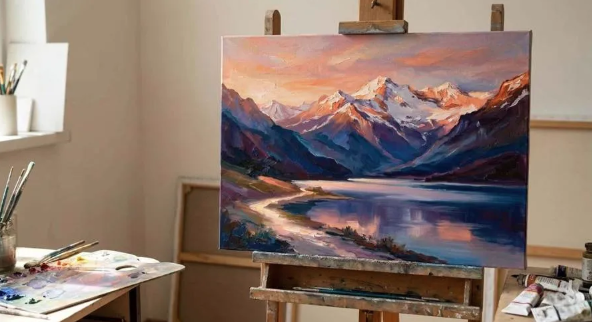
Stand close to a painting. Really close. You will see the ridges of paint, the texture of the canvas beneath and the places where the brush dragged or loaded up. This does not photograph well, and it absolutely doesn’t survive reproduction as a flat print.
The art historians have a term: facture, the visible evidence of how the work has been made. It’s part of the meaning of the painting. Strip it away with a smooth, flat print and you have taken off a layer of artwork communication .
Collectors who invest in handmade paintings often describe this physical presence as the core reason they buy originals. You can put a print in your living room and it looks alright. But a good original picture fills the room in a different manner: harder to define, but at the same time instantly recognizable.
Authenticity and Provenance Add Financial Weight
The art market runs on documentation. When you purchase an original painting you have a chance to locate its history of the owners – who created it, when and where it was exhibited, who owned it before you. This chain of provenance is part of what you’re purchasing.
On the other hand,for digital prints there exists a kind of ownership ambiguity. Even signed and limited-edition prints carry less documentation than certificates of authenticity on an original work. Provenance is known to increase the price of a painting by two or three times in an auction room.
This is important not only symbolically but practically as well:
- Art works can be highly valued with time particularly when the reputation of the artist improves.
- A print typically does not.
- This difference is the entire game to many buyers particularly those who consider long term value.
Emotional Connection and Intention
There’s also something harder to quantify: the sense that an original painting was made for the world, while a print was made for the market.
When an artist paints something, there is a direct line between the painter’s intentions and the object that you are holding in your hands. All the choices, from color, scale, composition, etc., were made by a human being struggling through a problem. When you buy a print, you’re buying documentation of that process. The original is the process itself, which you purchase when you purchase the original.
This emotional weight is not poetic only.It affects how people live with art. Owners of original works consistently report feeling more connected to them, more likely to look at them daily, more likely to know the artist’s story. That’s not nothing .
So, Is a Print Ever Worth It?
Absolutely. The fact that prints make art accessible to people who couldn’t be able to afford original work and there’s value in that . There are artists who create remarkable print editions which are noteworthy objects in themselves.
But if you’re asking why original paintings command the prices they do, why that canvas on the gallery wall costs what a used car costs, the reason is this: you are not only buying a picture. You are purchasing a unique object, a piece of someone’s time and intention, something that has been and will never be in the world in almost the same form.
That’s a different category of thing. And the market, for all its quirks, has that part exactly right.
Whether you’re a seasoned collector or simply fallen in love with a painting at the local show, knowing what makes originals special, will help you make smarter decision-making, as well as enjoy the pictures and paintings on your walls a little better.