

In the competitive landscape of American education, the ability to communicate with precision is the ultimate differentiator. Success is not just about having great ideas; it is about the linguistic infrastructure used to deliver them. Whether you are standing at a podium for a presentation or submitting a final thesis, your grasp of grammar and structure defines your authority.
Why English Fluency is the Key to Academic Success in the USA
In the USA, academic success is built on two pillars: Oral Fluency and Written Accuracy. A student who can navigate the nuances of the English language is perceived as more credible and prepared. However, the transition from learning basic rules to applying them in high-pressure environments remains a significant challenge for many.
1. Mastering Public Speaking: 2-Minute Speech Topics for Students
Public speaking is a core requirement in the US curriculum, from middle school through graduate programs. To build the “mental muscle” needed for quick language retrieval, experts recommend practicing with short, timed exercises.
By utilizing a variety of 2 minute speech topics, students can practice high-level grammatical structures like Conditionals (“If the government were to…”) and Modal Verbs (“We should consider…”) in a low-pressure environment.
Persuasive & Argumentative Topics (Focus on Rhetoric)
- The Future of Work: Should the 4-day workweek be standardized across the USA?
- Education Reform: Why financial literacy should be a mandatory high school subject.
- Technology: Is social media’s impact on democracy more negative than positive?
- Space Exploration: Why the US should prioritize Mars missions over lunar bases.
- Ethics: Should AI-generated art be eligible for copyright protection?
- Urban Planning: Should US cities become “car-free” in downtown areas?
Narrative & Personal Growth Topics (Focus on Tense Consistency)
- Resilience: Describe a time you failed and what it taught you about the “American Dream.”
- Inspiration: If you could spend one hour with any historical figure, who would it be?
- Culture: The most misunderstood aspect of your local community.
Abstract & Philosophical Topics (Focus on Complex Syntax)
- Success: Is it better to be a “jack of all trades” or a master of one?
- Happiness: Can a digital-first world truly satisfy human social needs?
- Time: If you could slow down one year of your life, which would it be?
- Justice: Does the modern legal system prioritize punishment over rehabilitation?
2. Transitioning from Public Speaking to Formal Academic Writing
While a speech allows for some verbal flexibility, the written word in American universities is unforgiving. Moving from an oral presentation to a formal research paper requires a total shift in Syntax and Tone.
The requirement to adhere to strict formatting styles like APA, MLA, or Chicago while maintaining a sophisticated “Academic Voice” can be overwhelming. For students struggling with these nuances, utilizing a professional academic support service can act as a bridge, providing a high-quality template for future independent work.
3. Essential US Academic English Grammar Rules & Standards
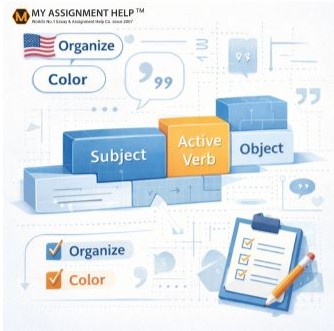
| Linguistic Feature | US Academic Standard | Correct Example |
| Voice | Active Voice preferred | “The team analyzed data” (Direct). |
| Spelling | American English | Use Organize and Color (not Organise/Colour). |
| Punctuation | Inside Quotations | “The results were inconclusive.“ |
| Serial Comma | Highly Recommended | “Apples, oranges, and bananas.” (Oxford Comma). |
4. How to Structure College Assignments for Maximum Impact
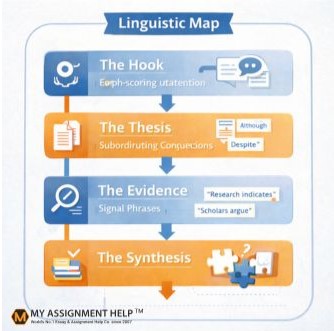
Every high-scoring paper in the USA follows a specific “Linguistic Map”:
- The Hook: A grammatically sharp opening sentence that defines the problem.
- The Thesis Statement: A complex sentence using subordinating conjunctions (e.g., “Although,” “While”) to show a nuanced argument.
- The Evidence: Using signal phrases (e.g., “According to,” “Research indicates”) to integrate external sources.
- The Synthesis: The final paragraph using conclusive transitions (e.g., “Therefore,” “Consequently”) to tie your speech topics and written arguments together.
5. Overcoming Writer’s Block in Academic and Public Speaking
The hardest part of any task is starting. For oral practice, choosing from a list of 2 minute speech topics eliminates the paralysis of choice. For written tasks, outlining your assignment based on the rubrics provided by US institutions is the first step toward success.
If the complexity of the task exceeds your current linguistic level, an academic support service can provide a learning tool that helps you understand the “DNA” of American academic writing.
Conclusion: Your Path to Linguistic Mastery
Grammar is not a set of cages; it is a set of wings. By practicing with short, focused speech topics, you develop the speed and confidence to speak your truth. By mastering the formal requirements of your essays, you ensure that your written legacy is one of excellence. In the end, when you own the language, you own the room.
Frequently Asked Questions (FAQs)
1. How do I choose the best 2 minute speech topics for a US college class?
The best topics are “debatable” and current. Professors look for your ability to take a stand and support it with logic.
2. Why is “Active Voice” so important in American academic writing?
It makes your writing direct and authoritative. In US universities, “wordiness” is often penalized.
3. Is it legal to use an academic support service in the USA?
Yes, using these services as a tutoring or reference tool is legal and common for understanding complex rubrics and formatting standards.
4. What are the most common grammar mistakes in US assignments?
The three most common issues are Comma Splices, Tense Inconsistency, and Incorrect Citations (failing to match APA 7th edition or MLA 9th edition requirements).
Author Bio:
I’ve spent the last 15 years in US lecture halls helping students turn complex ideas into persuasive arguments. My career has been dedicated to decoding the ‘unspoken rules’ of American academia—from the nuances of the Oxford Comma to the structural demands of a PhD thesis. Having taught at several top-tier universities, I’ve seen firsthand how mastering the English language can be the ultimate door-opener for students. I write these guides to provide you with the linguistic tools and the confidence you need to own any room you walk into.