

In an era dominated by instant messages and emails, the informal letter stands out as a personal and thoughtful way to communicate. Unlike formal correspondence, an informal letter allows you to express yourself freely, sharing stories, emotions, or updates with loved ones. It’s important because it fosters deeper connections, preserves memories, and adds a tangible touch to relationships that digital alternatives often lack.
When and Why You Need to Write an Informal Letter

You might reach for an informal letter when you want to go beyond a quick text or call. Common scenarios include catching up with a distant friend after months of silence, thanking a relative for a meaningful gift, or inviting family to a special event like a birthday gathering.
Why bother? In a fast-paced world, these letters show effort and sincerity. They help maintain bonds during life changes, such as moving to a new city or starting a new job. For instance, if you’re feeling homesick, penning your thoughts can provide emotional relief while making the recipient feel valued. Research from educational sources emphasizes that informal writing strengthens personal ties by allowing authentic expression.
Consider real-world needs: After a family reunion, you could write to recap fun moments and plan the next one. Or, during holidays, an informal letter can convey warm wishes more personally than a generic card. Ultimately, it’s about nurturing relationships when face-to-face interaction isn’t possible.
User Challenges or Common Mistakes in Writing Informal Letters
Many people hesitate to write informal letters because they overthink the process. A common challenge is striking the right balance—being too stiff makes it feel impersonal, while being overly casual might come across as sloppy.
One frequent mistake is ignoring structure altogether, leading to rambling content that’s hard to follow. For example, jumping from topic to topic without transitions confuses the reader. Another issue is poor grammar or spelling, which, even in casual writing, can distract from your message. Users often forget that informal doesn’t mean unpolished; as per writing guidelines, checking basics like spelling is crucial to maintain clarity.
Cultural differences pose challenges too. If English isn’t your first language, idioms or slang might not land well, causing misunderstandings. Real-life scenario: Imagine writing to an old school friend abroad and using local jargon that baffles them. Additionally, procrastination is common—people delay because they fear the letter won’t be “perfect,” missing opportunities to connect.
Overcoming these? Start small, focus on genuineness, and proofread. Recognizing these pitfalls empowers you to write with confidence.
Difference Between Formal and Informal Letter
Understanding the difference between a formal and informal letter is crucial to avoid mixing styles and confusing your intent. Formal letters, often used in business or official contexts, follow strict structures with professional language, no contractions, and polite but distant tone. They include elements like subject lines, formal salutations (e.g., “Dear Sir/Madam”), and closings like “Yours sincerely.”
In contrast, an informal letter is relaxed, conversational, and personal. It uses contractions (e.g., “I’m” instead of “I am”), slang if appropriate, and warm greetings like “Hi [Name]” or “Dear [Nickname].” The tone is friendly, with room for humor, emotions, and anecdotes, making it feel like a chat. Formal writing avoids first-person pronouns excessively, while informal embraces “I” and “you” to build intimacy.
Key differences include:
- Structure: Formal has rigid formats; informal is flexible, often without headings.
- Language: Formal is objective and precise; informal is subjective and expressive.
- Purpose: Formal requests action or informs officially; informal shares personally or entertains.
- Length: Formal is concise; informal can meander if it suits the relationship.
Mixing them, like using formal closings in a personal note, can make your letter seem cold. Aligning with industry norms, such as those in educational resources, ensures your communication hits the mark.
Step-by-Step Guide to Writing an Informal Letter
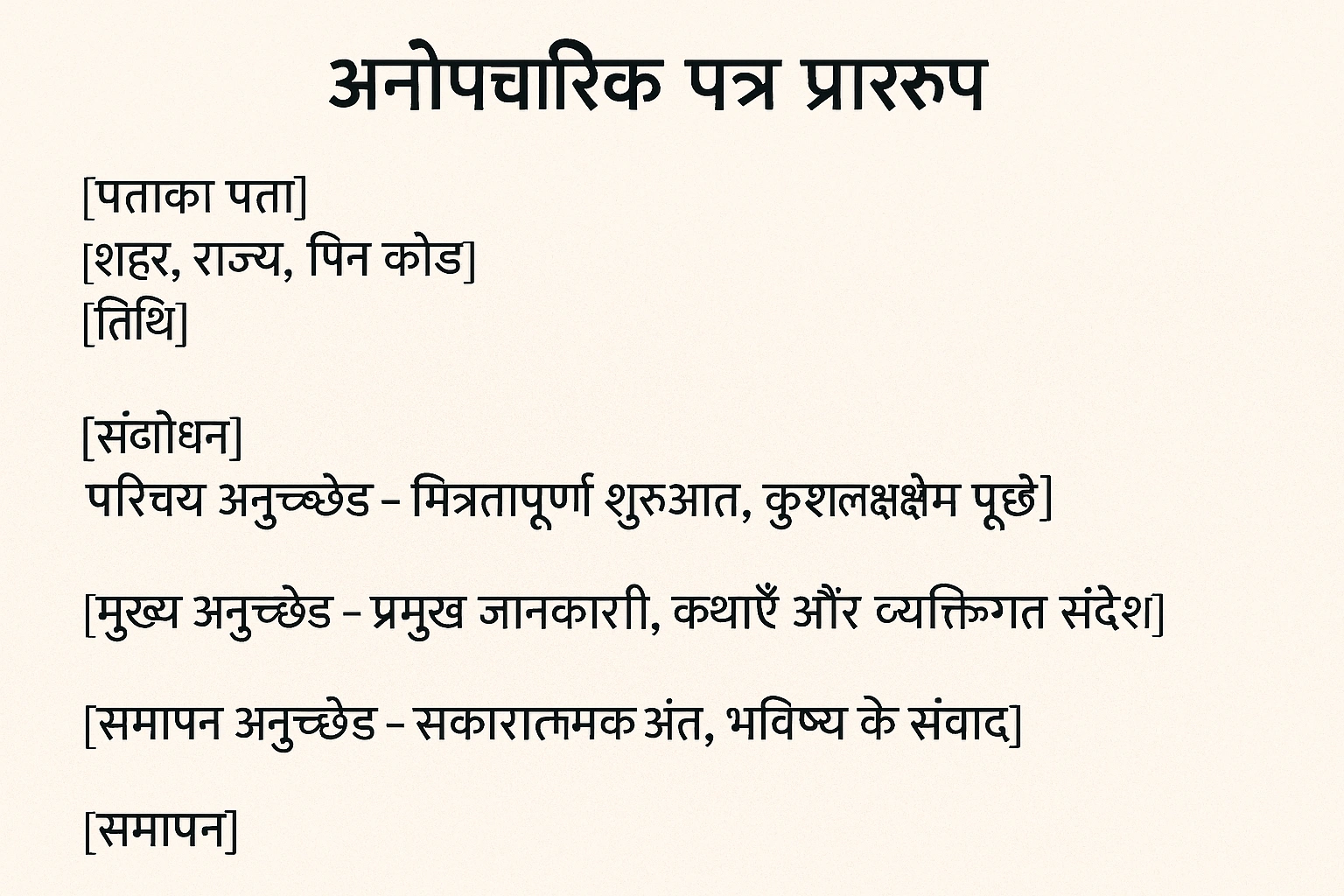
Crafting an informal letter is straightforward once broken down. Follow these steps to create something meaningful.
- Choose Your Purpose and Recipient: Decide why you’re writing—sharing news, expressing gratitude, or seeking advice. Tailor it to the person; a letter to your best friend will differ from one to a cousin.
- Gather Your Thoughts: Jot down key points. What stories do you want to share? Include personal anecdotes to make it engaging.
- Set Up the Format: Include your address and date at the top. This adds a professional touch without formality.
- Write the Salutation: Use warm greetings like “Dear [Name],” or “Hi [Nickname],” to set a friendly tone.
- Craft the Body: Start with an introduction, dive into main content, and end with a wrap-up. Keep paragraphs short for readability.
- Add a Closing: Sign off with “Best regards,” “Love,” or “Cheers,” followed by your name.
- Review and Revise: Read aloud to check flow. Ensure it’s conversational, as informal writing thrives on personal pronouns and slang.
This guide turns a daunting task into manageable actions, helping you produce a letter that resonates.
Essential Components and Format of an Informal Letter
An informal letter has flexible but essential parts to ensure it’s coherent.
- Sender’s Address and Date: Place this at the top right. It helps the recipient reply easily. Example: Your street, city, postcode, followed by the date like “August 13, 2025.”
- Salutation: Personal and warm, e.g., “Dear Sarah,” Avoid generic ones unless it’s very casual.
- Introduction Paragraph: Hook the reader. Mention how you’ve been or reference a shared memory.
- Body Paragraphs: The heart of the letter. Divide into 2-4 paragraphs covering different topics. Use transitions like “Speaking of which…” for smooth flow.
- Closing Paragraph: Summarize thoughts, express future hopes, like “Can’t wait to hear from you.”
- Sign-Off: Match the relationship— “Yours truly” for acquaintances, “With love” for close ones.
Format-wise, use lined paper or a word processor with 1-inch margins. Handwriting adds personality, but type if your script is illegible. Best practices suggest using colloquial language to keep it relatable.
These components make your letter organized yet relaxed.
Tips for Clarity, Tone, and Impact in Informal Letters
To make your informal letter shine, focus on these practical tips.
✅ Clarity: Use simple sentences. Avoid jargon unless shared. For impact, be specific—say “I laughed so hard at that movie we watched last summer” instead of vague statements.
✅ Tone: Keep it friendly and positive. Incorporate humor or empathy based on context. Informal style allows contractions (e.g., “I’m” instead of “I am”) and first-person pronouns for a conversational feel.
✅ Impact: Add questions to engage, like “How’s your new job going?” This encourages a response. Vary sentence length for rhythm—short for emphasis, longer for details.
📌 Key Takeaway: Proofread for errors, as even casual letters benefit from polish. If emotional, let it sit overnight to refine tone.
📌 Another Tip: Personalize with inside jokes or references to build trust and connection.
These strategies, drawn from communication norms, ensure your letter leaves a lasting impression.
Examples and Templates of Informal Letters
Here are three ready-to-use examples in different contexts, plus templates. Adapt them to fit your voice.
Example 1: Catching Up with a Friend After a Trip
[Your Address]
[Date: August 13, 2025]
Dear Mike,
Hope this finds you well! I’ve just returned from that backpacking trip in Europe I was raving about. Paris was magical—the Eiffel Tower at night is something else. Remember how we dreamed about it in college? I tried escargot and surprisingly loved it!
How about you? Still crushing it at your graphic design gig? Let’s plan a reunion soon. Miss our late-night chats.
Take care,
Alex
This example uses personal anecdotes for warmth.
Example 2: Thanking Family for Support During Tough Times
[Your Address]
[Date: August 13, 2025]
Hi Aunt Lisa,
I wanted to drop a line to say thanks for being there during my job transition last month. Your advice about networking really paid off—I landed a role at that tech firm! It’s been hectic settling in, but exciting too.
The kids send their love; little Emma drew you a picture (enclosed). How’s Uncle Bob’s garden coming along? We’d love to visit soon.
With gratitude,
Jamie
Here, gratitude and family updates create emotional impact.
Example 3: Inviting a Sibling to a Family Event
[Your Address]
[Date: August 13, 2025]
Hey Sis,
Guess what? We’re throwing a surprise party for Dad’s 60th on September 20th. It’s at the old lake house—barbecue, games, the works! Can you make it? Bring the fam; the cousins will be thrilled.
I’ve been busy with wedding planning (yes, it’s official!), but this will be a great break. Spill the beans on your latest adventures.
Love you,
Taylor
This invitation is lively and inclusive.
Template 1: General Catch-Up
[Address/Date]
Dear [Name],
[Intro: Recent update or shared memory]
[Body: Details on life, questions for them]
[Closing: Future plans]
[Sign-off]
Template 2: Gratitude-Focused
[Address/Date]
Hi [Name],
[Thanks for specific thing]
[How it helped + personal news]
[Invitation or well-wishes]
[Sign-off]
Template 3: Invitation
[Address/Date]
Hey [Name],
[Event details]
[Why they should come + fun elements]
[Personal touch]
[Sign-off]
These provide starting points, ensuring your informal letter feels authentic.
Final Checklist Before Sending Your Informal Letter
Before sealing the envelope or hitting print, run through this checklist:
✅ Does it start with a warm salutation and end with a fitting sign-off?
✅ Is the tone friendly and personal, using “I” and “you” naturally?
✅ Have you included specific details or questions to engage the reader?
✅ Checked for spelling/grammar errors? Even informal letters deserve a quick scan.
✅ Is the content concise yet complete—avoiding rambles?
✅ Added any enclosures, like photos, if mentioned?
✅ Ensured it’s respectful and positive, aligning with ethical communication?
This quick review boosts confidence and effectiveness.
Conclusion: Embrace the Power of the Informal Letter
Writing an informal letter is more than a task—it’s a bridge to meaningful connections. By following this guide, you’ve got the tools to overcome challenges, craft impactful messages, and strengthen relationships. Whether sharing joy or support, these letters create lasting memories.
Don’t wait for the perfect moment; grab a pen today and reach out. You’ll be amazed at the warmth it brings back. Remember, in a digital world, a handwritten note stands out—start yours now!
FAQ’S ?
1. What exactly is an informal letter?
An informal letter is a personal, casual letter written to friends, family, or acquaintances. It uses a conversational tone, allowing you to share updates, express feelings, or invite someone to an event, unlike formal letters that follow strict rules.
2. How do I start an informal letter if I haven’t written one before?
Begin with your address and date at the top, followed by a warm salutation like “Dear [Name]” or “Hi [Nickname].” Open with a personal touch, like mentioning a recent event or asking how they’re doing, to set a friendly tone.
3. Can I use slang or abbreviations in an informal letter?
Yes, slang and abbreviations are fine if they suit your relationship with the recipient and won’t confuse them. For example, “LOL” works with a close friend but might puzzle an older relative. Keep it natural but clear.
4. How long should an informal letter be?
There’s no strict rule, but aim for 1-2 pages (300-600 words) to cover key points without rambling. Short paragraphs keep it readable. Focus on quality—share meaningful details rather than filling space.
5. What’s the difference between an informal letter and an email?
An informal letter is often handwritten or printed, giving it a tangible, personal feel, while emails are digital and quicker. Letters allow for enclosures like photos and feel more thoughtful, but both can be casual in tone.
