

A relieving letter is a formal document issued by an employer to a departing employee, confirming that the individual has been officially released from their duties and responsibilities. It serves as an acknowledgment that all exit formalities—such as handover of tasks, return of company assets, and settlement of dues—have been completed satisfactorily. Typically provided after an employee’s resignation or termination, this letter acts as a bridge between past and future employment.
From my experience, relieving letters are particularly prevalent in regions like India, where they are a standard part of the employment lifecycle, but their use is growing globally as companies prioritize clear records. For instance, in multinational firms I’ve worked with, these letters help prevent disputes over unfinished obligations. According to HR resources, it’s an official confirmation of resignation and relief from duties. Without it, transitioning to a new role can feel like carrying unresolved baggage.
Disclaimer
This blog post is for informational purposes only and is not legal or professional advice. Employment laws vary by region; consult a qualified professional for tailored guidance. The author and publisher are not liable for errors, omissions, or outcomes from using this content. Verify information with authoritative sources before acting.
Why is it Important for Employees and Employers?
For employees, a relieving letter is more than paperwork—it’s a passport to new opportunities. It proves to potential employers that you’ve left your previous job on good terms, with no pending issues that could raise red flags during background verification. In my years advising job seekers, I’ve seen how lacking this document can delay onboarding or even cost someone a dream job. It’s especially crucial in competitive markets, where recruiters scrutinize employment histories for gaps or inconsistencies.
Employers benefit equally. Issuing a relieving letter provides legal protection by documenting that the employee has fulfilled all contractual obligations, reducing the risk of future claims related to unpaid dues or incomplete handovers. It also enhances the company’s reputation as a fair and organized entity, which is vital for attracting top talent. In one case from my career, a startup I consulted for implemented standardized relieving processes, which not only complied with regulations but also boosted employee satisfaction scores by 20%. As per industry insights, it’s a formal way to close the employment chapter for both parties.
Difference Between a Relieving Letter and an Experience Letter
It’s easy to confuse these two documents, but they serve distinct purposes. A relieving letter focuses on the end of your tenure: it confirms your resignation date, last working day, and that you’ve been relieved without liabilities. It’s concise and factual, emphasizing closure.
An experience letter, on the other hand, is a testimonial of your time with the company. It details your role, responsibilities, achievements, and overall performance, often used to showcase skills in job applications. While a relieving letter says “goodbye,” an experience letter celebrates “what you accomplished.” In my expertise, employees sometimes request both simultaneously, but employers might issue them separately based on policy.
To illustrate, if you’re applying for a promotion-heavy role, the experience letter highlights your growth, whereas the relieving letter simply verifies your exit. Expert analyses confirm this distinction: the former is about separation formalities, the latter about contributions.
What Should a Proper Relieving Letter Include?
A well-crafted relieving letter ensures clarity and professionalism. It should be on company letterhead, dated, and addressed to the employee. Key elements include:
Key Elements
- Employee Details: Full name, employee ID, designation, and department.
- Employment Period: Joining date and last working day.
- Confirmation of Relief: A statement that the employee has been relieved from duties as of a specific date.
- Conduct and Clearance: Mention of satisfactory conduct and completion of all formalities, like no dues pending.
- Wishes for Future: A positive note wishing success, to maintain goodwill.
- Signature: From an authorized HR representative or manager.
In my practice, including these prevents ambiguities that could arise later.
Template/Example
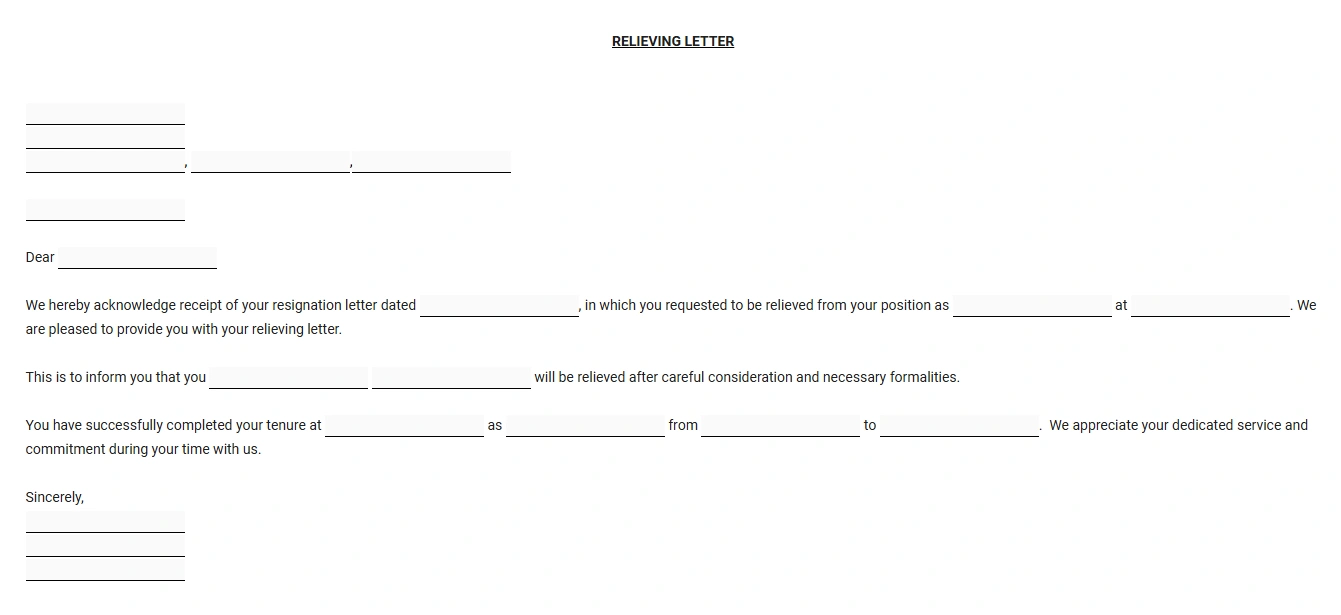
Let’s delve into the relieving letter format to make it practical. Here’s a simple template I’ve adapted from standard HR practices:
[Company Letterhead]
[Company Address]
[Date][Employee’s Name]
[Employee’s Address]Subject: Relieving Letter
Dear [Employee’s Name],
This is to certify that [Employee’s Name], Employee ID [ID], who was employed with [Company Name] as [Designation] in the [Department] from [Joining Date] to [Last Working Date], has been relieved from their duties effective [Relief Date].
All handover formalities have been completed, and there are no outstanding dues or obligations from either side. During their tenure, [Employee’s Name] demonstrated professionalism and contributed positively to the team.
We wish [Employee’s Name] all the best in their future endeavors.
Sincerely,
[HR Manager’s Name]
[Designation]
[Contact Information]
[Signature]
This example is straightforward and can be customized. For more variations, such as for executives or teachers, resources provide tailored samples. Remember, keeping it positive fosters long-term relationships.
Legal and Compliance Considerations
Legally, relieving letters vary by jurisdiction. In India, under the Industrial Employment (Standing Orders) Act and new Labour Codes effective in 2025, employers are mandated to issue them upon request, especially for establishments with 10+ employees. Failure can lead to grievances filed with the Labour Commissioner. Globally, while not always statutory (e.g., in the US or Europe, where at-will employment prevails), it’s a best practice under data privacy laws like GDPR or India’s DPDP Act 2023, ensuring accurate employment records.
Compliance-wise, ensure the letter aligns with company policies and local laws on notice periods and severance. In 2025, with gig economy growth, platforms must issue similar documents for freelancers to avoid disputes. From my experience, proactive compliance reduces litigation—I’ve helped companies audit processes to stay ahead.
How to Request a Relieving Letter Professionally
Requesting this document should be polite and timely. Start by emailing HR or your manager shortly after your last day, referencing your resignation and exit clearance.
Sample Email:
Subject: Request for Relieving Letter
Dear [HR Manager’s Name],
I hope this email finds you well. I am writing to formally request my relieving letter following my resignation from [Company Name]. My last working day was [Date], and I have completed all necessary formalities.
Please let me know if any additional information is required. I appreciate your assistance in this matter.
Best regards,
[Your Name]
[Contact Details]
In my advisory roles, I’ve found that following up in person or via call builds rapport. Always keep records of communications for reference.
What to Do If an Employer Refuses to Provide One?
Refusals, though rare, can stem from unresolved issues like notice buyouts. First, send a formal reminder via registered mail, citing legal obligations. If ignored, escalate to the Labour Department in India or equivalent bodies elsewhere—complaints often resolve quickly.
In extreme cases, consult a lawyer for a legal notice. From my encounters, most resolve amicably once authorities are involved. Alternatives include using payslips or self-attestations for new jobs, but persist for the official document. Empathy helps: understand the employer’s side, but stand firm on your rights.
Tips from HR Experts
Drawing from my network and experience:
- Issue promptly: Aim for within 7-10 days post-exit to aid transitions.
- Be positive: Even in tough departures, neutral language preserves reputation.
- Digitize: In 2025, use secure portals for e-letters to speed processes.
- Train managers: Ensure they understand legal nuances to avoid errors.
- For employees: Request early and follow up politely.
Experts emphasize clear communication to prevent issues.
Closing Thoughts
Job transitions are milestones, often filled with excitement and uncertainty. As you move forward, remember that documents like these are tools for empowerment. In my 10+ years, I’ve witnessed how handling them well builds resilience and networks.
Common Myths and FAQs
Myth : Relieving letters are the same as experience letters.
Fact: As discussed, they’re different—one ends, the other summarizes.
Myth : Employers can withhold them indefinitely.
Fact: In regulated markets, timelines apply, and withholding without cause is illegal.
FAQ: Is it mandatory?
A: In India, yes for many firms; globally, it’s advisable.
FAQ: What if I’m fired?
A: You can still request one, though wording might differ.
Myth : You need three warnings before termination affects the letter.
Fact: No such rule; it’s about fair process.
