
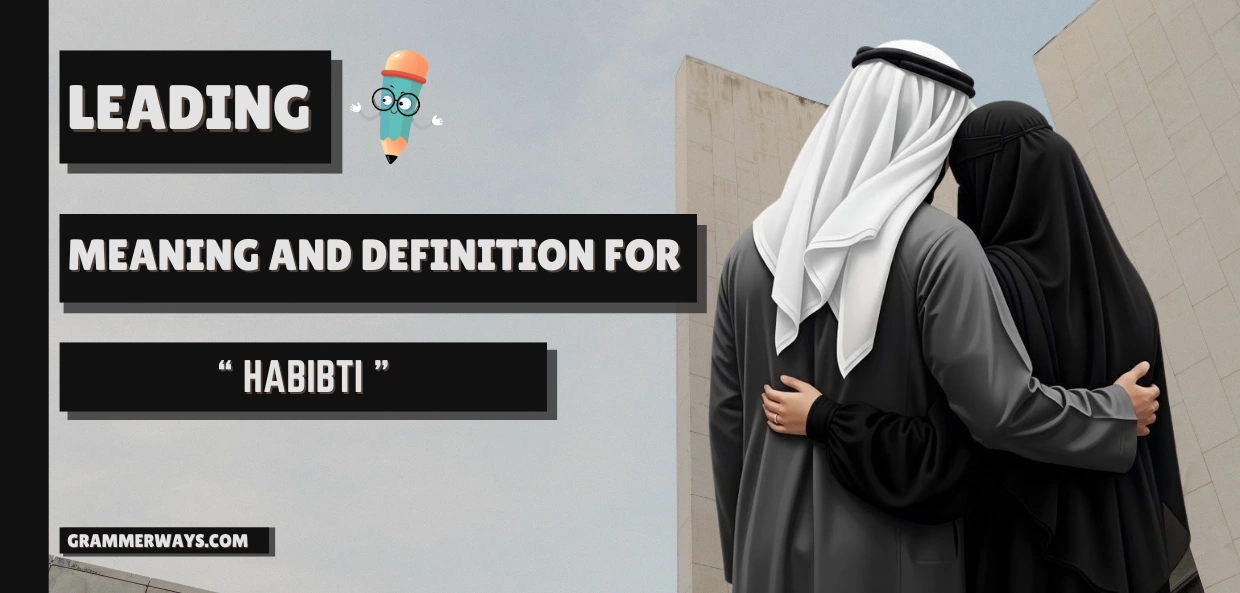
Every language has that one word the one that wraps warmth, affection, and belonging into a single breath. In Arabic, habibti is exactly that word.
If you’ve heard it in a conversation, a song, or a film and wondered what it means, you’re not alone. Millions of people search habibti meaning every month, and the curiosity makes sense. It’s a word that sounds intimate even before you know what it means.
Here we covers everything worth knowing: the exact meaning, how to say it correctly, how it differs from habibi, what helwa habibti means, where the word comes from, and how to use it without getting it wrong.
Grammatical Overview: Habibti Meaning
Part of speech: Noun (used functionally as a term of address / vocative)
Phonetic spelling: ha-BEE-bee-tee
IPA transcription: /ħaˈbiːbtiː/
Script: حبيبتي
Root: ح-ب-ب (ḥ-b-b) — the Arabic trilateral root for love
Habibti is a gendered, possessive noun. It breaks down as:
- حبيب (ḥabīb) — beloved / dear one
- ة (-a/-at) — feminine suffix (makes it feminine)
- ي (-ī) — first-person possessive suffix meaning “my”
So the literal translation is “my beloved (female)” or “my darling (female)” — though in natural speech, people translate it simply as “my love.”
Origin & Etymology: Where Does This Word Come From?
The root ح-ب-ب (ḥ-b-b) is one of the most ancient and productive roots in the Semitic language family. It appears in Classical Arabic texts dating back well over 1,400 years, including in Quranic Arabic where forms of this root appear in verses about love and devotion.
Habib as a word for “beloved” was already common in pre-Islamic Arabic poetry — the qasida tradition — where poets addressed their subjects with intimate endearments. The feminine form habibti follows the same Classical Arabic grammatical structure that has remained essentially unchanged across dialects.
Related forms in other Semitic languages:
- Hebrew: ahava (אהבה) shares the broader conceptual space of love
- Aramaic: similar roots appear in historical religious texts
- Modern Standard Arabic: ḥubb (حب) means love; maḥbūb/maḥbūba means beloved (male/female)
The word moved across cultures through trade, empire, and migration. Today it appears in Egyptian, Levantine, Gulf, Moroccan, and Iraqi dialects — each with slightly different intonation but the same core meaning.
Habibti Pronunciation: Getting It Right
Habibti pronunciation trips up many non-Arabic speakers because of the ح (ḥ) — a pharyngeal fricative that doesn’t exist in English.
Here’s a practical breakdown:
| Syllable | Sound | English Approximation |
|---|---|---|
| ḥa- | Breathed “h” from the throat | Like whispering “ha” with a raspy edge |
| -bī- | Long “ee” sound | Like “bee” |
| -b- | Standard “b” | Normal English “b” |
| -tī | “tee” | Like the letter T |
Quick tip: If the pharyngeal ح sounds too difficult, a regular English “h” is widely understood and far better than skipping it entirely. Native speakers will still know what you mean.
Full word rhythm: Two syllables carry stress — ha-BEE-bee-tee — with a slight emphasis on the second syllable.
Habibi vs Habibti: What’s the Actual Difference?
This is the most common point of confusion, and the answer is straightforward.
Habibi (حبيبي) = “my love / my darling” — used when addressing a male
Habibti (حبيبتي) = “my love / my darling” — used when addressing a female
Arabic is a grammatically gendered language, so the suffix changes depending on who you’re speaking to — not who is speaking. A man calls his girlfriend habibti. A woman calls her girlfriend habibti. The speaker’s gender is irrelevant; the listener’s gender determines the form.
| Term | Gender of Person Addressed | Meaning |
|---|---|---|
| Habibi (حبيبي) | Male | My love / my darling (to him) |
| Habibti (حبيبتي) | Female | My love / my darling (to her) |
One genuine edge case worth noting: in very casual Egyptian and Levantine speech, some younger speakers use habibi as a gender-neutral exclamation — similar to how “dude” works in English. But in any sincere, emotionally meaningful context, the gendered forms still apply. When in doubt, match the suffix to the person you’re addressing.
Detailed Usage: When and How People Actually Use It
Understanding habibti meaning is one thing; knowing how to use it naturally is another. Here’s where it gets interesting.
Between romantic partners: The most familiar context. Partners address each other with habibti/habibi as casually as English speakers say “babe” or “honey.” It doesn’t signal formality — it signals closeness.
Between close female friends: Especially common in Egyptian and Levantine Arabic. Two women who are close friends will call each other habibti constantly, the same way some English speakers call each other “babe” without any romantic meaning. This surprises people who assume it’s exclusively romantic.
From parent to child: A mother calling her daughter habibti is completely standard and deeply warm. It’s a term of unconditional affection, not just romantic love.
In customer service and hospitality: Across Arab-speaking countries — particularly in Lebanon, Jordan, and Egypt — it’s common for a shopkeeper or host to address a female customer as habibti as a way of being warm and welcoming. It softens transactions and creates a sense of personal connection.
Grammar collocation note: Habibti almost always appears at the beginning or end of a sentence when used as an address. It is rarely mid-sentence in natural speech.
Helwa Habibti: A Phrase Worth Knowing
Helwa habibti (حلوة حبيبتي) translates as “beautiful, my darling” or “you’re lovely, my love.”
Helwa (حلوة) is the feminine form of helw (حلو), meaning beautiful, sweet, or lovely. Combined with habibti, it becomes one of the most affectionate phrases in colloquial Arabic — something a mother might whisper to a daughter, or a close friend might say after a compliment.
You’ll hear helwa habibti meaning come up in the context of Egyptian and Levantine pop songs, which is likely why searches for the phrase have grown steadily since 2023 as Arabic music has gained international streaming audiences.
Synonyms & Near-Equivalents
| Arabic Term | Transliteration | Meaning / Nuance |
|---|---|---|
| حبيبة | Habiba | Beloved (feminine noun, non-possessive) |
| عزيزتي | Azizati | My dear (more formal, slightly elevated) |
| روحي | Rouhi | My soul / my spirit (intensely intimate) |
| قلبي | Albi | My heart (very affectionate, common in songs) |
| غاليتي | Ghaliyati | My precious one (used in formal and literary contexts) |
| يا حلوة | Ya helwa | Oh, beautiful one (affectionate address) |
Note on antonyms: Because habibti is a term of endearment rather than a descriptive adjective, there is no direct antonym. The closest functional opposite in conversational Arabic would simply be the absence of such terms — using someone’s name or a more neutral address signals distance or formality.
Example Sentences: Habibti Meaning
1. “تعالي هنا، حبيبتي.”
Ta’ali hina, habibti.
“Come here, my love.” — A mother calling her daughter.
2. “كيف حالك، حبيبتي؟”
Keif halak, habibti?
“How are you, my darling?” — Friends greeting each other.
3. “أنتِ حلوة جداً، حبيبتي.”
Anti helwa jiddan, habibti.
“You’re so beautiful, my love.” — A partner giving a compliment.
4. “لا تقلقي، حبيبتي، كل شيء تمام.”
La tiqlaqi, habibti, kull shi tamam.
“Don’t worry, darling, everything is fine.” — Comforting a friend.
5. “يا حبيبتي، اشتقت إليكِ.”
Ya habibti, ishtaqt ilayki.
“Oh my darling, I missed you.” — Upon reuniting with a close friend or family member.
6. “حبيبتي، هذا الفستان يليق بكِ.”
Habibti, hatha al-fustan yaleeq biki.
“Darling, that dress suits you perfectly.” — Said warmly by a shop assistant or friend.
Common Mistakes and What to Watch Out For
Using habibi when addressing a female: This is the most frequent error. It’s not offensive, but it is grammatically incorrect and can sound slightly odd to native speakers.
Spelling errors in romanization: You’ll see habibti, 7abibti, ḥabibti, and even habebti — all refer to the same word. The 7 is a common Arabic internet convention representing ح. In formal writing, stick with habibti.
Assuming it’s always romantic: As covered above, this is a term of affection used freely between friends and family. Using it with a close female friend is completely normal and doesn’t carry romantic implication.
Overusing it with strangers: While hospitality culture makes it common in some service contexts, calling a professional contact habibti in a formal email or first meeting can feel presumptuous. Context matters.
Cultural and Contextual Significance
Arabic has an extraordinarily rich tradition of love poetry — arguably the most developed in the ancient world. Terms like habibti carry the weight of that tradition. The word appears in classical ghazal poetry, in Quranic exegesis discussing the nature of devotion, and in modern Arabic pop music alike.
In contemporary Arab diaspora communities — particularly in the United States, France, and the UK — habibti has crossed into multilingual speech. It’s common to hear second-generation Arab-Americans drop it naturally into English sentences: “Come on, habibti, let’s go.” This code-switching signals cultural pride and intimacy simultaneously.
Did you know? The name Habiba — a popular given name for girls across North Africa and the Middle East — comes from the same root as habibti. It literally means “the beloved one.”
Tips to Remember the Word
- Associate the root ḥ-b-b with love — once you know it, related words like ḥubb (love), maḥbūb (beloved), and ḥabīb (dear) all click into place.
- Remember the gender rule with a simple pattern: -i ending = speaking TO a male; -ti ending = speaking TO a female.
- Think of habibti as the Arabic equivalent of “my darling” — warm, versatile, and fitting in many relationships.
Related Words and Word Family
| Word | Arabic | Meaning |
|---|---|---|
| Hubb | حب | Love (the noun) |
| Habibi | حبيبي | My love (to a male) |
| Habib | حبيب | Beloved (male, non-possessive) |
| Habiba | حبيبة | Beloved (female, non-possessive) |
| Mahboub | محبوب | Popular / loved (adjective, male) |
| Mahbouba | محبوبة | Loved, popular (adjective, female) |
| Tahabob | تحابب | To love one another (reciprocal verb form) |
Read Also: Disappearing Messages Meaning in Marathi
Related Expressions and How the Word Has Evolved
The digital age has done interesting things to habibti. On Arabic Twitter and TikTok, it appears in ironic or humorous contexts — friends tagging each other with “ya habibti” the way English speakers use “bestie” or “queen.” It’s also appeared in reaction memes across Arabic-speaking social media communities.
In 2024 and 2025, Arabic music’s growing global footprint — driven by streaming platforms and viral content — has introduced habibti and helwa habibti to listeners who have never studied Arabic. Search data from late 2024 shows a notable spike in habibti meaning queries correlating with popular Arabic songs charting internationally.
This cross-cultural spread is not trivializing the word — if anything, it’s amplifying genuine curiosity about Arabic language and culture, which is worth taking seriously.
Conclusion: Habibti Meaning
The habibti meaning is simple on the surface — “my love” or “my darling” addressed to a female — but the word carries layers that a translation alone can’t capture. It spans the distance between a mother and child, between lifelong friends, and between partners. It lives in centuries of Arabic poetry and in today’s viral music. Understanding habibi vs habibti, knowing when helwa habibti fits, and getting habibti pronunciation right all open a small but genuinely meaningful window into one of the world’s richest linguistic traditions. Use it with the warmth it deserves.
? FAQs About Habibti Meaning
Is habibti formal or informal?
It is informal and affectionate. It belongs in personal relationships, casual conversation, and warm social settings. You wouldn’t use it in a business email or a job interview.
Can a man use habibti?
Yes — a man calls his female partner, daughter, sister, or close female friend habibti. The word describes the gender of the person being addressed, not the speaker.
Is habibti only used in one Arabic dialect?
No. It appears across virtually all Arabic dialects — Egyptian, Levantine, Gulf, Moroccan — with slight pronunciation differences but the same meaning and warmth.
What does ya habibti mean?
Ya (يا) is a vocative particle in Arabic — equivalent to “O” in old English (“O my darling”). Ya habibti simply means “Oh my love” or “Hey darling” and is extremely common in spoken Arabic.
Is it appropriate to use habibti with someone I just met?
In hospitality-oriented contexts like restaurants or shops in Arab countries, it’s common and warm. In professional Western contexts, it may feel too familiar. When uncertain, follow the other person’s lead.
